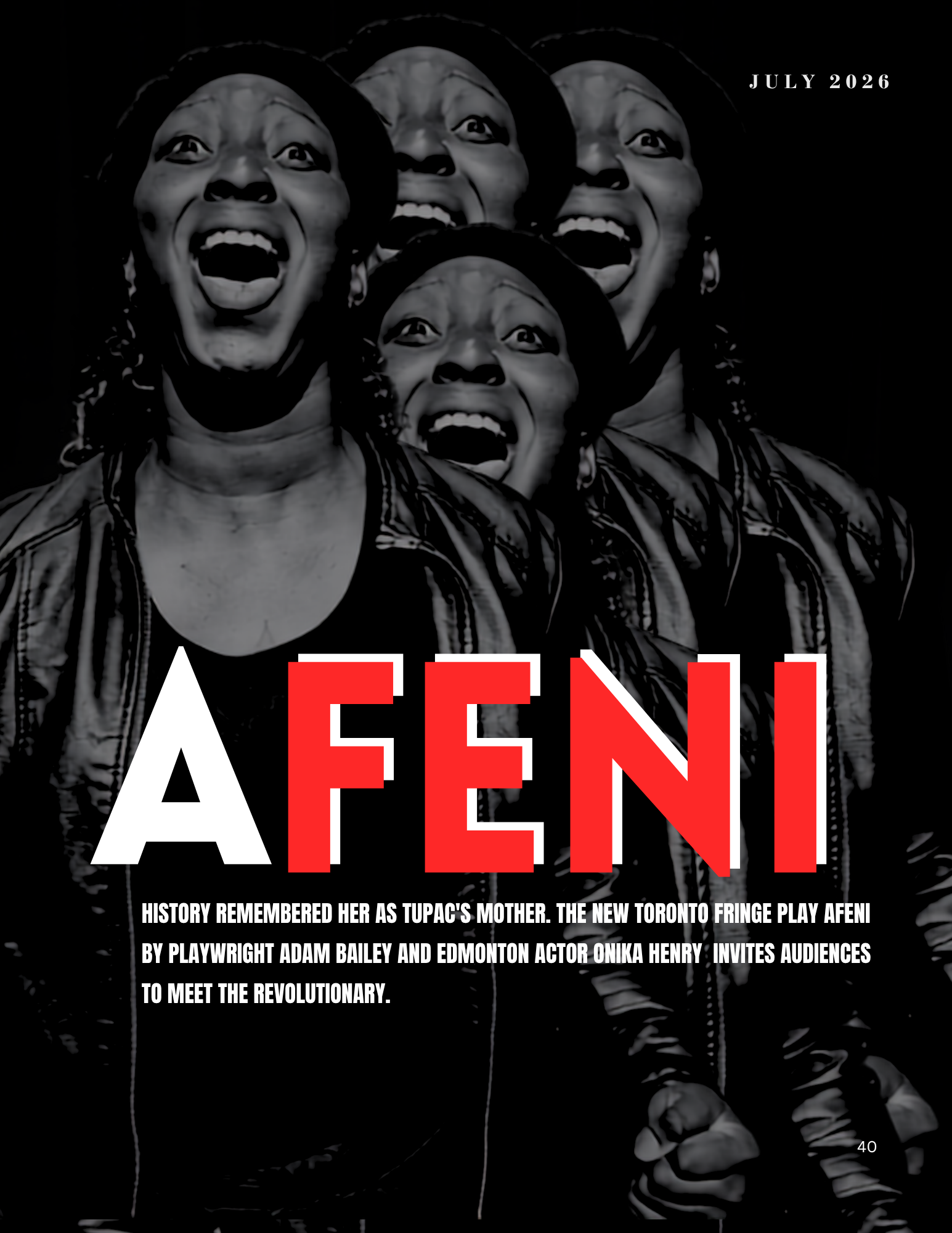
For Edmonton actor and educator Onika Henry, portraying Afeni was never about stepping into the shadow of a legend. It was about bringing audiences face-to-face with the woman history too often leaves in the margins.
The courtroom is full.
A 23-year-old Black woman rises to her feet.
She is pregnant.
She has no legal training.
Before her stands the full weight of the American justice system.
The State believes it has already won.
She decides they will not.
Long before the world knew Tupac Shakur, Afeni Shakur was changing history in her own right.
For many, Afeni Shakur's identity begins and ends with being the mother of one of hip-hop's greatest icons. Yet long before Dear Mama immortalized their relationship, she was Alice Faye Williams, a young woman searching for purpose who would become an organizer, educator, community leader and one of the most remarkable figures of the Black Power movement. Her story is not simply one of resistance, but of refusing to let someone else define who she was.
That is the woman audiences will meet in Afeni, the acclaimed stage production making its Toronto Fringe debut after a celebrated premiere at the Edmonton International Fringe Festival.
For Edmonton actor and educator Onika Henry, portraying Afeni was never about stepping into the shadow of a legend. It was about bringing audiences face-to-face with the woman history too often leaves in the margins.
"I want people to see Afeni the human being, and not Tupac's Mom. She is a woman of many identities, and being Tupac's Mom is only one of those identities."
It is a deceptively simple statement.
Because once audiences begin to look beyond the mythology, they discover a woman whose life reads less like folklore and more like extraordinary determination.
Born Alice Faye Williams in North Carolina before moving to New York, Afeni joined the Black Panther Party in 1968 after searching for something that gave her life direction. Within a remarkably short time, she became an organizer, recruiting new members, helping establish community initiatives including the Party's Free Breakfast Program, writing for its newspaper and advocating for neighbourhoods too often ignored by those in power.
Then, in April 1969, everything changed.
Arrested alongside twenty other members of the Black Panther Party in what became known as the Panther 21 trial, Afeni found herself facing more than 150 criminal charges. The trial would become the longest and most expensive in New York State history at the time.
Against the advice of many around her, she chose to represent herself.
Months later, every defendant was acquitted.
One month after walking free, she gave birth to the child who would later be renamed Tupac Amaru Shakur.
Remarkably, that is not the story Afeni chooses to tell.
Tupac is mentioned only briefly.
Instead, the production asks audiences to sit with the woman before the myth.
"What strikes me most about Afeni's humanity is that she, just as we all have, struggled to find her purpose in life. She didn't start off as a Black Panther. She had to search for what she found meaningful to give her that sense of purpose, as we all do. She's just as human as I am, made mistakes like I do, and made a significant impact in a way I hope to by bringing Afeni to the Fringe."
Perhaps that is what makes the production resonate so deeply.
It refuses to place Afeni on a pedestal.
Instead, it reminds audiences that extraordinary people often begin as ordinary people searching for where they belong.
Although the events portrayed in Afeni unfolded more than fifty years ago, Henry believes the play speaks directly to the present.
"All the moments of solidarity in Afeni feel more relevant to me considering the times we are currently in. Afeni's story is a powerful reminder that we as people are stronger when we set aside our differences and realize that as a community we are loud. In unity, we have the power to topple systems."
Solidarity sits at the heart of the production.
Continue reading in the Afros in tha City July 2026 Digital & Print Issue, available now.
Afeni is playing as part of the 2026 Toronto Fringe Festival, running June 30–July 12, 2026. For tickets and show information, visit the Toronto Fringe Festival online.