
There is something quietly powerful about discovering a story you were never taught.
Not because it was hidden in a dramatic way, but because it simply wasn’t prioritized. It didn’t make the curriculum. It didn’t make the classroom. It didn’t make the everyday language of what we call “Canadian history.”
And yet, it exists. Fully. Deeply. Undeniably.
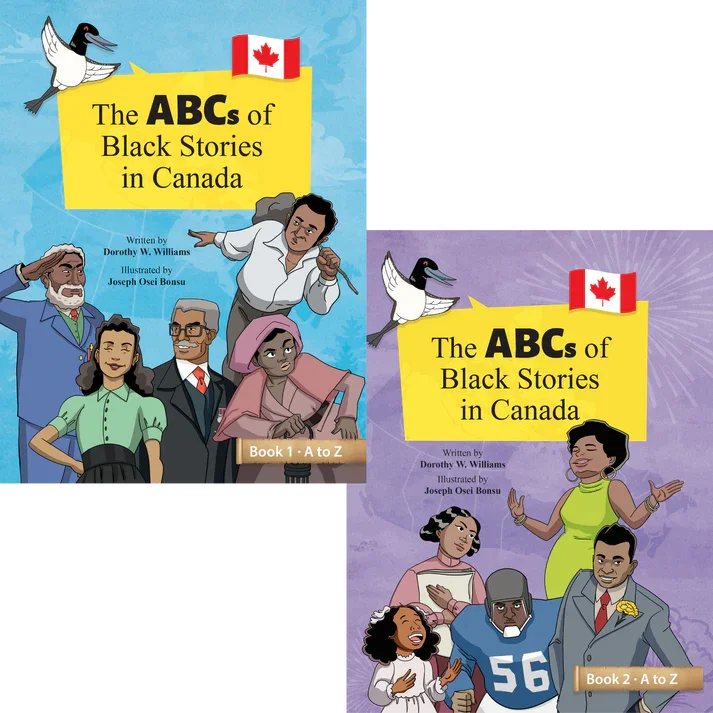
The ABCs of Black Stories in Canada (DC Canada Education Publishing) is not just a children’s book. It is a two-book set with a corrective lens. A reintroduction. A reminder that the story of Canada has always been more layered than what many of us were taught to believe.
Written by Dr. Dorothy W. Williams and illustrated by Joseph Osei Bonsu, the collection presents 52 stories of Black resilience, courage, and contribution organized alphabetically across two volumes, but grounded in lived experience. It is accessible in format, but expansive in meaning.
Because what happens when a child learns that someone like Harry Jerome once broke records that the world said couldn’t be broken? What happens when they see that excellence, struggle, and triumph have always been part of their story. Not separate from it? Something shifts.
Perhaps more importantly, what happens when we, as adults, encounter these stories for the first time?
The Stories That Shape Us
In one of the featured entries, we meet Harry Jerome. A Canadian sprinter whose journey was marked by both brilliance and adversity. After achieving what many thought impossible, breaking the 10-second barrier in the 100-yard sprint, his career was interrupted by injury. A torn muscle could have ended everything.
But it didn’t.
He returned. He competed. He won.
The story is simple on the surface. But underneath it is something deeper. A pattern we see repeatedly in Black history: interruption, resistance, continuation.
The ability to come back.
The Gap in Our Learning
In the introduction, Dr. Dorothy Williams reflects on her own childhood. Growing up in Montreal, surrounded by stories of local trailblazers, yet never being taught about Black Canadian figures in a broader national context.
She writes:
“In schools and community centres, I never learned about national heroes, or great men and women whose exploits made a difference in other parts of the country. No one had a Canadian tale about Black people to share with little children who love stories.”
This absence matters. Because when history is incomplete, identity becomes fragmented. When stories are omitted, belonging becomes conditional.
We learn about Abraham Lincoln and Frederick Douglass rightfully so. But how often are we taught about Kay Livingstone, whose advocacy helped establish Black History Month in Canada?
How often do we understand that Black presence in Canada is not recent, not peripheral, and not secondary but foundational?
Why This Work Matters Now
We are in a time where conversations around representation, identity, and cultural memory are becoming more visible. But visibility alone is not enough. We need structure. We need documentation. We need storytelling that is intentional and accessible across generations.
That is what The ABCs of Black Stories in Canada offers.Not just for children, but for families. For educators. For communities who are still piecing together narratives that should have been whole from the beginning.
The Power of Simplicity
There is something perceptively powerful about the format of this book. Alphabetical. Illustrated. Concise.
It removes intimidation. It invites curiosity. A child can open the book and learn something new in minutes. A parent can read alongside them and discover something they themselves never knew. A teacher can integrate it into a classroom without needing to restructure an entire curriculum.
The illustrations by Joseph Osei Bonsu do more than accompany the text, they animate it. They offer visual entry points for young readers while reinforcing the dignity, movement, and humanity within each story. This is how cultural knowledge spreads. Not always through grand gestures, but through consistent, accessible entry points.
A Living Archive
What this book set ultimately becomes is a living archive. Not in the traditional academic sense, but in a way that is felt. Shared. Passed on. It documents not only achievements, but presence. It says:
Black history was here. Black history is here. Black history has always been here.
And for a country like Canada, often framed through narratives of diversity and inclusion, this kind of work grounds these ideals in reality.
Relearning, Together
There is a quiet humility required in engaging with work like this.
To admit: “I didn’t know this.” And then to continue learning anyway.
Because these stories are not just for children discovering the world for the first time. They are for all of us who are unlearning, relearning, and expanding our understanding of where we are, and who we are within it.
As Dr. Williams reminds us:
“This compilation of stories of Black experiences lived within Canada spans hundreds of years. It is more than just a footnote to the Canadian story.”
The Work Continues
There is no single book that can capture the entirety of Black experience in Canada. But this is a start.
A meaningful one. A necessary one. An accessible one.
Because the next generation deserves to grow up with a fuller understanding of the country they call home. And we deserve to catch up to the stories we missed.
Beyond the Page
Dr. Williams makes it clear that this work is not simply additive. It is foundational. This is the shift. Not just to acknowledge these stories, but to understand that they have always been part of the story.
Because this time, we are not leaving them out. This time, we understand.
These stories were never missing.
We just weren’t told and now, we are. - Kimberley Dooshima Jev
This story is shared in partnership wtih DC Canada Publishing