
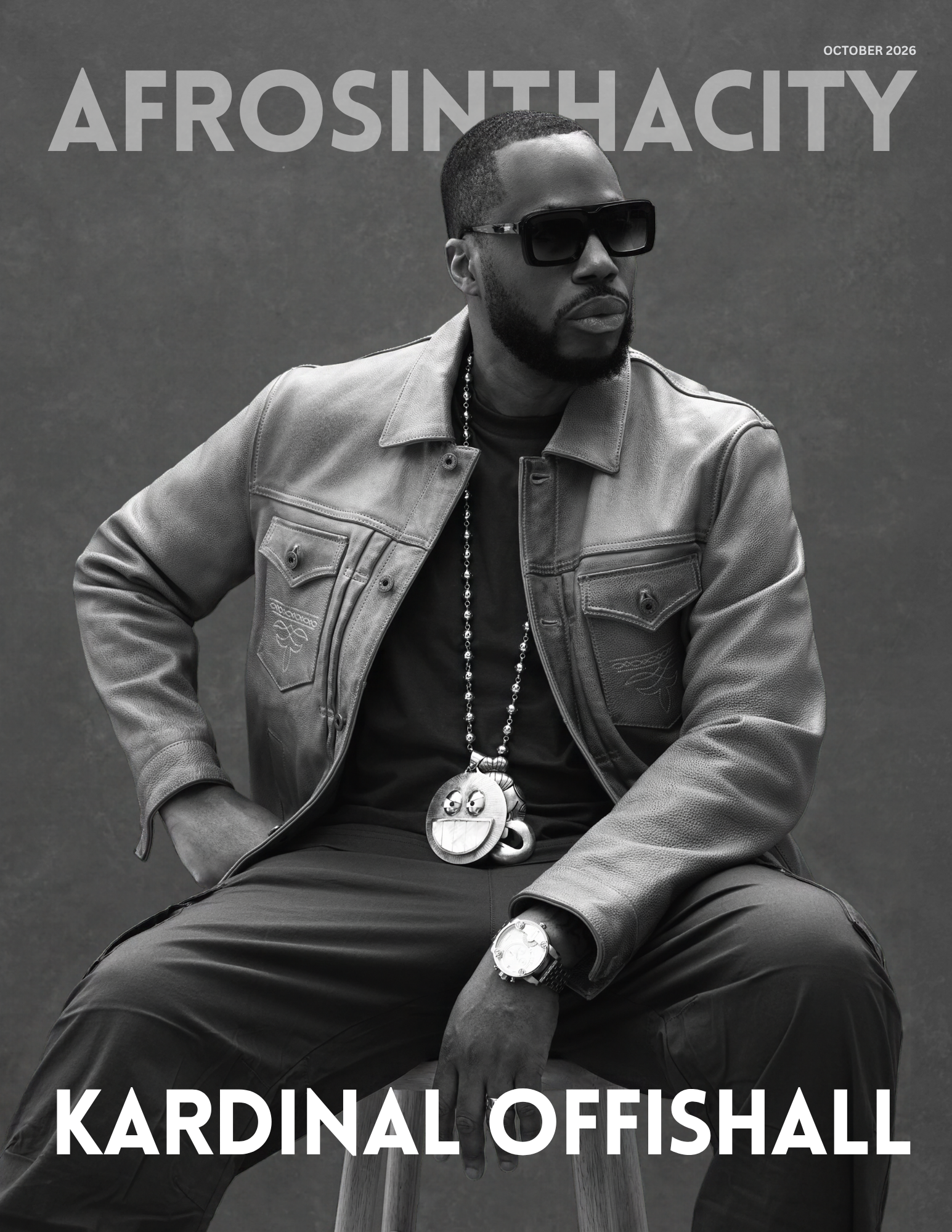
THE CURRENCY OF TIME
Kardinal Offishall on music, independence and the cost of staying in the game
By Kimberley Dooshima Jev
Kardinal Offishall thinks Canadian music journalism has a problem. Ask him what it has missed over the years and his answer comes quickly. “The layers.”
The problem, as he sees it, is not that Canadian artists have failed to make an impact. It is that Canada has not always done the work of explaining that impact to itself.
“What happens with music journalism in Canada is we are always happy to get one, so I think we focus more on that than the actual stories, the impact,” he tells Afros in tha City. “What it means to the communities, to the city, to the country.”
There are Canadian artists, he says, who have had real global impact without Canadians fully understanding the scale of what they have done.
“I don’t think that the reporting contextualizes things properly so that people even understand what their domestic artists are doing around the world.”
Canada, he argues, has a habit of looking elsewhere for validation. The United States. The United Kingdom. The Caribbean. Other countries have spent decades building narratives around their own artists while Canada often remembers individual achievements instead of whole careers.
“In Canada, we just go by the highlight reels,” he says.
“How much do people actually know about Melanie Fiona’s story? How much do we know about Glenn Lewis’s story? What do we know about Deborah Cox’s story?”
The names are not incidental.
Deborah Cox, born in Toronto, broke a then-record when “Nobody’s Supposed to Be Here” spent 14 consecutive weeks at No. 1 on Billboard’s R&B chart. In 2022, she became the first Black woman inducted into the Canadian Music Hall of Fame.
Glenn Lewis represents another chapter of Canadian R&B. “Don’t You Forget It” earned a 2002 JUNO nomination, his album World Outside My Window followed with another in 2003, and “Back For More,” featuring Kardinal Offishall, was nominated for R&B/Soul Recording of the Year in 2004.
Melanie Fiona’s career carries that story into another generation. She has earned two Grammy wins from five nominations.
These are not artists Canada failed to produce. They are examples of careers whose scale can become easier to recognize abroad than to fully document at home.
It is an interesting place to begin a conversation with Kardinal Offishall because his own career can easily become exactly what he is describing: a highlight reel.
The records. The collaborations. The executive roles. Television. Touring. A&R. Decades inside Canadian hip-hop and, increasingly, inside the institutions that decide which music gets funded, promoted, marketed and heard.
His new album, Firestarter Vol. 2: Everyday, Sometimes…, offers another way into that story.
Kardinal says the record is different because he is allowing people closer than he has before.
“Firestarter Volume 2 is the first time for me that I think that I truly found bravery,” he says. “It is the first time that I am giving the fans, and even people just discovering me, an unadulterated, transparent view as to what my life has been like and what has made me the person that I am.”
That transparency includes marriage. Kardinal has been with his wife for more than 20 years. On “When You’re In Love,” featuring Melanie Fiona, he describes the first verse as something close to a letter to her. “People don’t really discuss it that often, especially in hip-hop, but marriages are not easy,” he says. “A lot of work.”
Hip-hop has produced countless songs about falling in love, getting married and celebrating the wedding. Kardinal is more interested in what happens after everyone goes home.
“Do you talk about going to therapy? Do you talk about the missteps? Do you talk about what you could have done better? Do you talk about reflecting, and then using that reflection to inform your future decision making?”
The record also makes room for grief.
On “Heavy Is the Head,” Kardinal reflects on losing his father and what he calls life in the “no fathers club.”
“My father was very present up until the day that he passed,” he says. “My father was very, very present and instilled family values, morals and all the good stuff to myself and my sister.” For Kardinal, these are not departures from hip-hop. They are what should happen when the people making hip-hop are allowed to grow.
“Hip-hop is growing up now.” –Kardinal Offishall
“As a genre that’s 50-plus years old, some of us have been kids and are growing into full-fledged adults. There’s even some grandparents in hip-hop right now, but the stories can’t remain the same.”
The energy cannot stay frozen either. “We can’t be juveniles forever.” Kardinal makes a distinction between hip-hop being young and hip-hop being youthful. “I don’t think that hip-hop is a youth genre more than I say it’s youthful,” he explains.
There is still room for play. There is still room for energy. Growing older does not mean losing access to the younger version of yourself.
“I have a big sign in my studio that says, ‘Don’t grow up. It’s a trap,’” he says. “That’s the beauty of being creative and being an adult. You can always tap into your inner younger self for the vibes, but you just couple that with the wisdom that you were able to accumulate over the years.”
That wisdom has also come from seeing the music business from both sides.
Inside the machine
Kardinal did not always want to work inside major labels.
He remembers a conversation with Randy Lennox, then president and CEO of Universal Music Canada, that eventually led to an invitation. Kardinal would formally join Universal Music Canada in 2013 as Creative Executive Director of A&R, moving from artist into the institutional side of record-making. He was promoted to Senior Vice President of A&R in 2021.
“He said, ‘Choose your title,’” Kardinal recalls. “‘In the book of my life, I definitely want for there to be a chapter where me and you work together.’”
The offer did not immediately appeal to him. “The labels were the enemy at the time,” Kardinal says. “I did not want to be a part of the system at all.”
A conversation with Stephen Marley, the nine-time Grammy-winning reggae artist and son of Bob Marley, helped change his mind. Kardinal remembers telling Marley that he was not interested in joining the label system. “He said, ‘Yo, the only way to change the system is from within. That’s the only way you’re going to be able to change the system.’”
Marley told him that people like Kardinal needed to be sitting at those tables. “You can represent us properly,” Kardinal remembers him saying. That helped push him into the executive side of the business. The experience did not erase his skepticism.
“Like any other corporation, it’s a trip,” he says. “There are some people that really do love music and the art itself. There’s a lot of people who, it’s really about the money first.” Still, working inside the system taught him how the machinery operates. Kardinal calls it being on “the other side of the Iron Curtain.”
“Not everybody has the opportunity to really, like in a car, lift up the hood and see how the engine actually works,” he says. Knowing how the engine works changes what independence looks like when you return to it.
“It means struggle”
Ask Kardinal what independence means in 2026 and his first instinct is not to romanticize it.
“It means struggle.”
He remembers his earliest independent years as a teenager, scraping together money for studio time and working part-time jobs to fund music. The landscape is different now. “When we started as teenagers, the independent space was more streamlined and there were more identifiable markers that let you know when you are seeing success.” Those markers are harder to find today.
“There are hundreds of platforms and we’re inundated with just so much of everything,” he says. “It just feels like you have a machine gun and you’re shooting your machine gun into the sky, hoping that a bird falls.”
That, he says, is what independence can feel like in 2026. “Sure, there are some key performance indicators, but the thing is, those are also rigged.” Kardinal does not describe his current independence as doing everything alone. He points to his own team and to Foundation Media, a company specializing in distribution and label services that lists Firestarter Vol. 2 among its releases.
The distinction matters. Independence here is not the absence of infrastructure. It is assembling that infrastructure differently.
“What I do know is that it’s powered by myself and my team.”
Without the departments of a major label moving together behind a release, the work becomes granular. “Maybe you’re boxing it out for the next three weeks where you’re going to do them one by one, piece by piece.” He uses a Jamaican saying to describe the accumulation of small wins: “Every mickle mek a muckle.”
Each person who finds the record matters.
“Independence also allows you to be thankful for everything.”
The contrast is unusual because Kardinal still works within the major-label system through Def Jam while independently releasing his own music. He knows both experiences at the same time. “On the independent side, it’s me invigorating myself,” he says. “It’s my management reminding me to say, ‘Hey, we’re on a mission. Stay focused on the goal.’”
Kardinal had a phrase for this even during his major-label years. “Independent hustle with a major-label muscle.” The phrase has changed. “Right now, it’s independent hustle, but with independent muscle as well.”
The currency of time
The conversation changes when Kardinal starts talking about attention. The old battle was easier to understand. An artist made a record. A listener had money. The artist wanted some of that money. “You were trying to beg them to take that little ten dollars and buy your CD,” he says. Now, Kardinal argues, the scarce resource is different.
“We are fighting for the currency of time.”
His new album runs about 36 minutes. The challenge is convincing someone to surrender those minutes. “Now we are fighting to say to people, ‘Listen, please. I need that 36 minutes for you to listen to this album.’” Then he makes the distinction plainly.
“We’re not fighting for their money. We are fighting for attention.”
That shift has changed the job. Artists are told to post constantly. Release constantly. Stay visible. Feed platforms. Keep moving before the last thing has even had a chance to land. “They tell us, ‘Hey, well, that means you have to post every day. That means you have to release five albums a year.’” Kardinal has little interest in living that way. “For somebody like me, that’s not something that I want to participate in.” Ignoring the environment is not an option either.
His metaphor is a circus, where the question becomes which job you are willing to do inside it.
“As long as you want to be in the circus, you just got to figure out what your role is going to be within that circus. Are you going to be the ringmaster? Are you going to be the person that’s juggling, doing the tricks?”
Kardinal is still figuring that out. “For me, I’m still trying to maintain that balance.”
Social media becomes part of that balancing act. Some posts work. Others do not. Kardinal says it can be debilitating for artists when a piece of content fails to gain traction and they interpret that as personal failure. His goal is to find ways of participating that still feel like him. “That’s why the album is called Everyday, Sometimes…,” he says. “There’s gotta be two things can be true.”
A person can be influential and serious about what they stand for while still having fun. Technology, however, will continue moving whether an artist feels ready or not. “You have to figure it out.” Kardinal does not believe artists can simply pretend the shift is not happening.
“I don’t think that you can be one of those people that ignores what is happening, or else you’re just going to get lost very, very quickly.”
Where is the money?
Attention may be the new currency, but attention does not pay the bills by itself. So the question becomes more basic. Where is the money? How is Kardinal Offishall surviving? He corrects the premise.
“I am still thriving.” Survival mode, he says, is familiar, but it is not where he wants to live.
“I don’t wish to be in survival mode. That’s not a cute place to be in.”
The answer is diversification. “I am blessed to be able to not put all my efforts into one bucket.” Kardinal believes the modern creative economy increasingly demands skills beyond the art itself. “You have to be a promoter. You have to be an editor. You have to be a marketer. You have to be all these things.”
His own career reflects that. Television became another lane. A&R became another. He remembers his lawyer pointing out something Kardinal had not yet understood about himself. “Do you realize the skill set that you have? People get paid for that.” His lawyer pointed to the names Kardinal had brought to his attention early.
“Drake, Boi-1da, Glenn Lewis, Sean Paul,” Kardinal recalls. “You brought them to me early, early, saying, ‘Yo Theo, you gotta check for these people.’”
The list sounds casual until you place the names in context. Drake would become a five-time Grammy winner and one of Toronto’s most globally recognized rappers. Boi-1da became one of modern rap’s major producers, with credits including Drake’s “God’s Plan,” Rihanna’s “Work” and records by Kendrick Lamar and Beyoncé. Sean Paul’s Dutty Rock won the Grammy for Best Reggae Album. Glenn Lewis had already become a recurring JUNO nominee in Canadian R&B.
Kardinal’s point is not that he single-handedly made those careers. It is that, before he had the job title, he already had the instinct to hear talent early and move it through his network.
Kardinal says he did not understand that instinct as a profession. “I didn’t know that that’s what being an A&R was supposed to be.” He was doing it because he loved it. “I love discovering new people. I love curating sounds and helping people put together their things.” The same diversification now includes writing and production. “I produced 80 per cent of this album, so that means publishing. That means television and film sync.”
Live performance remains another pillar. “My knees are still good. Back is still good.” He laughs, then gets to the business. “Shows can be very lucrative.” Kardinal and his team have prioritized live performance since before his first major-label deal. “That’s what we’ve been doing since we were teenagers until now.” The larger lesson, he says, is not only for young artists.
“It’s an intergenerational skill to be able to diversify. What are your other passions, and how do you monetize those?”
“My output match my capabilities” Money is not the only thing still driving him. Asked what he remains ambitious for, Kardinal takes a moment. He wants his output to reach the level he knows he is capable of.
He compares it to being the student who can write an essay the night before, get an A, and still know the work did not represent his best.
“I know what I’m capable of.”
External praise is not enough if he knows he coasted. His ambition remains “in full gear.” The goal is simple: “My output match my capabilities.” That pursuit has had a cost.
Asked what all of this has cost him, Kardinal pauses. “Personal time.”
There was a period when he put music on pause because he did not want to miss his life. The decision came with another cost.
“There was a time in my life where I put music on pause because I didn’t want to miss the personal time, but then the personal time was having me not be able to participate and really execute with my career.”
Balance has not meant winning on both sides.
“In the pursuit of balance, I have lost a lot on both sides.”
There were family holidays and birthdays missed for work.
There were also stretches where choosing family led people to wonder what had happened to Kardinal the artist. “I’ve sat in rooms with some of my heroes where they are brought to tears because they have their career, and they have millions and millions, but that’s all they have.” They missed everything else. “I was like, I never want that to be me.”
Kardinal believes he is finally reaching a version of balance that works for his life.
“I am here for my kids. I’m here for my wife and for my family at large, for the most part, when they need me. That to me is super important.”
Career still matters because family life and financial security are not separate from it. “I can’t necessarily help them with certain things if I’m not successful with my career as well.” That may be the clearest meaning of the currency of time. The listener has 36 minutes.
The artist has birthdays, studio sessions, flights, meetings, school days, marriages, grief, ambition and a finite number of years in which to fit all of it.
What is owed
One of the album’s sharpest titles is “40 Acres And A Ferrari,” featuring Black Thought and Stove God Cooks. Kardinal traces the title to Stove God’s wordplay on 40 acres and a mule, the unfulfilled post-emancipation promise that has become shorthand for reparative justice in the United States.
“We still want those dreams to be fulfilled,” Kardinal says. “In 2026, a lot of us are still looking for our 40 acres and a Ferrari.”
The Ferrari does not have to be literal. “I think we are owed what is due to us.” Black Thought was also a bucket-list collaborator. “Being able to go bar for bar with one of my all-time favourite lyricists of all time, I had to make sure, performance-wise, I was at the top of my game.”
Kardinal is careful with the word “features” across the album. He prefers “collaborators.” “There was no song where I feel like somebody’s gonna listen and be like, ‘Ah, you just put this person on this song just because of the name.’” Melanie Fiona’s contribution came after hours of conversation in the studio before she entered the booth. “These are real contributors to the energy, to the content, the vibe, the sonics that I wanted to really get out.”
His goal was a journey. “By the time you finish this album, you’re going to feel like you’ve completed a journey.” The campaign is only beginning.
Kardinal says he is headed to New York for a run through some of hip-hop’s most visible interview and radio platforms, including Rory & Mal, Angela Yee, Hot 97 and Ebro at Apple Music. From there, the campaign moves toward the United Kingdom and the Caribbean.
“We’re really going on a Firestarter Volume 2 campaign.” His approach remains incremental. “Piece by piece. Just building, building and building.”
There is more happening in Toronto too. Kardinal says he recently signed a music ambassador deal with Monster Energy and wants to develop a recurring monthly event in the city. “We really need something here,” he says. “Gotta bring back our energy.” More than three decades into his career, Kardinal Offishall is still trying to figure out what his role inside the circus should be.
He has been the artist outside the institution and the executive inside it. He has had major-label muscle and independent muscle. He has chased records, protected his family, learned how the engine works and watched the currency of the business move from dollars to attention.
Kardinal Offishall is not talking about independence as uncomplicated freedom. He’s not talking about success as uncomplicated wealth. For Kardinal this isn’t about talking about longevity as simply staying visible. Kardinal is talking about learning what deserves your time.
Then making sure, while everyone else is fighting for a piece of it, that you keep some of it for yourself.