
What Will It Take for Us to Feed One Another?
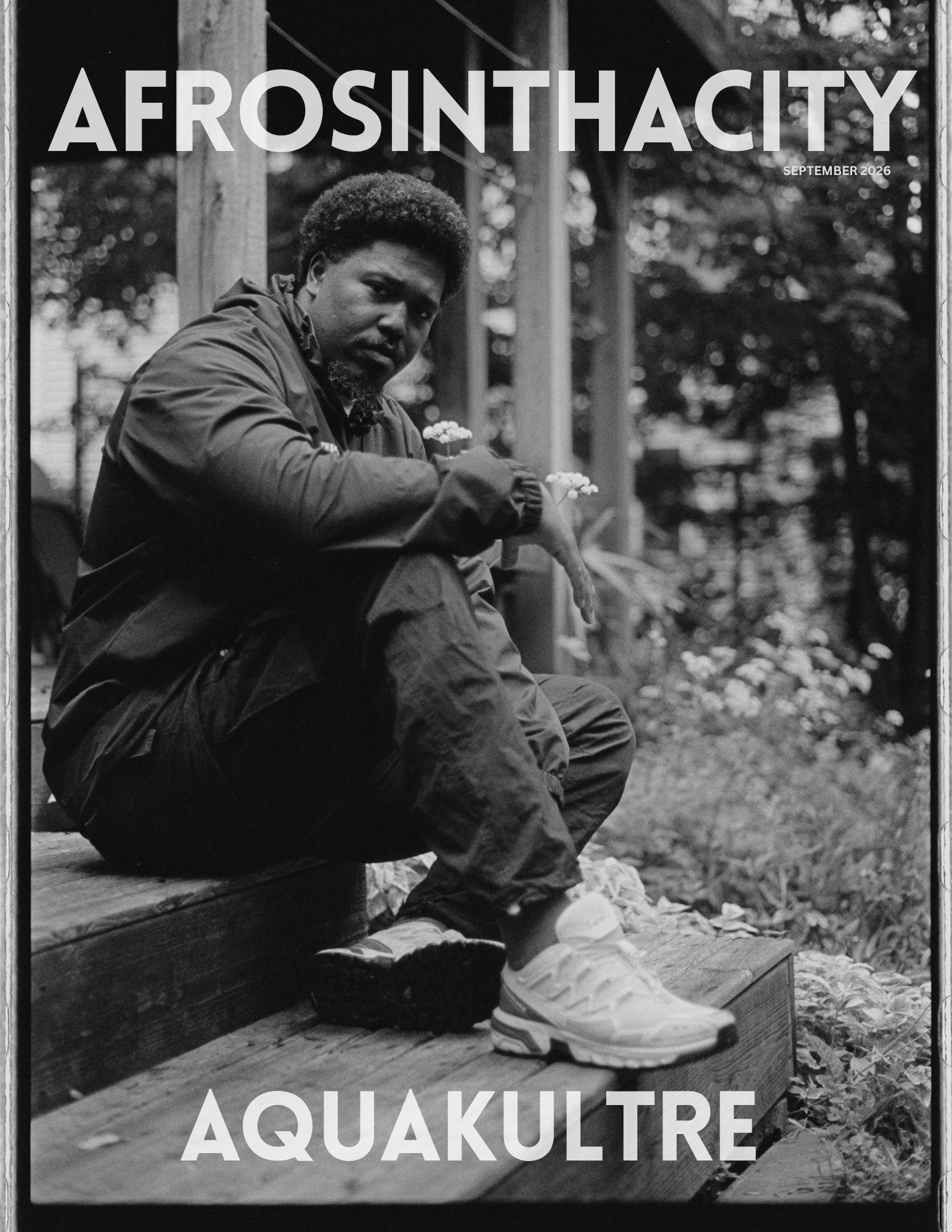
Through 1783 and Matriarchs, Aquakultre is transforming family memory into a living archive while asking Black Nova Scotian communities to remember how deeply they belong to one another.
By Kimberley Dooshima Jev
Lance Sampson was standing in front of a video kiosk at the Africville Museum when a familiar name appeared on the screen.
The woman speaking was his great-great-grandmother. Sampson had stumbled onto what he understands to be the only surviving recording of her voice. His first instinct was reverence. His second was hip-hop.
“I immediately went into hip-hop mode,”
he remembers. “Let me sample this right quick.” That impulse sits at the centre of Sampson’s work as Aquakultre: find what remains, listen closely, then give it somewhere new to live.
On 1783, his sweeping 2026 album rooted in nearly 250 years of Black Nova Scotian history, voices from his family move alongside gospel, soul, jazz, folk, R&B and hip-hop. The record reaches through the arrival of Black Loyalists, Jamaican Maroons and Black Refugees; through communities including Africville, East Preston, Weymouth Falls, Liverpool and Delaps Cove; and into the intimate histories Sampson inherited from the women in his family.
Now, that work is moving off the record and into a room.
On September 11, the Black Cultural Centre for Nova Scotia hosted a Community Listening Party and the launch of Matriarchs, the first element of Sampson’s larger 1783 installation. Created during his residency at the Centre with artistic collaborator Louisa Adamson, Matriarchs invites visitors into Nanny’s living room, a space animated by family voices, memory and the accumulated knowledge of generations of women.
The residency places Sampson’s work inside a longer archival tradition. Established in 1983, the Black Cultural Centre preserves African Nova Scotian history through documents, photographs, recordings, artwork and community artifacts. In 2025, after receiving the Black Artist Recognition Award, Sampson was appointed Artist-in-Residence at the Centre. From there, he and Adamson have been developing the larger 1783 installation, with Matriarchs as its first public element.
This is not nostalgia assembled behind glass. For Sampson, the grandmother’s living room is where the work of community repair begins.
“There are a lot of women that make up who you are,” he says. “There are a lot of different lines that make up who you are.”
The installation brings together recordings from four generations of his family: his great-great-grandmother Harriet Carvery, his great-grandmother Daisy Thompson, his grandmother Carolyn Sampson and his mother, Meteana Sampson. Some of those women never knew one another. Inside Matriarchs, their voices finally share a home.
The original version of the installation, presented at Halifax’s Nocturne festival, contained two living rooms, a kitchen and a wake area. The current iteration has been compressed into a larger living-room environment to make space for other components of the expanding 1783 exhibition. Audiences have nevertheless recognized it immediately. Visitors from Nova Scotia, elsewhere in Canada and the United States have seen familiar furniture, textures and domestic rituals reflected back at them.
In Sara Wai’s photographs from 1783: The Live Experience at Sanctuary at the Sanctuary Arts Centre in Dartmouth, Nova Scotia, history takes the shape of a room already known. Rocking chairs sit beneath the glow of pleated lamps. Family portraits line a lace-covered surface. A record player waits beside the instruments, while a guestbook invites visitors to leave their own names and memories behind. Children wearing headphones lean toward a television, encountering the archive at their own height. Nothing is held at a museum’s distance. The past is furnished, sounded out and made available to another generation.
The familiarity matters. Sampson describes the living room as the warmest place in the house: the room where grandparents sit, families gather and somebody eventually tells you who belongs to whom. That knowledge, he argues, could change how people see one another.
Who Belongs to Whom
Sampson grew up in Uniacke Square, a public-housing community in Halifax’s north end. His generation learned neighbourhood loyalties early. The Square, Mulgrave Park, East Preston and North Preston could become identities as much as locations, with old tensions passed forward long after people had forgotten how closely their families were connected.
“Instead of camaraderie and understanding, it was more like, ‘If you’re from a certain neighbourhood, then we don’t mess with you,’” he says.
He traces much of that fracture to the drug and gang cultures that shaped his generation. Communities became boxed into neighbourhood identities rather than understood within the broader history of Black Nova Scotia. Young people knew where somebody was from, but not necessarily who their grandparents were.
Sampson now wonders what might have changed if they had listened more carefully in those living rooms.
“Our grandparents are cousins,” he says. “Let’s hang. Let’s get to know each other.”
That is the deeper function of Matriarchs. Genealogy becomes more than a personal search for names and dates. It becomes a challenge to the logic of community conflict. If the person across town is connected to your family two generations back, the inherited boundary between “us” and “them” begins to look less permanent.
The installation is directed particularly toward Black men of Sampson’s generation. He wants them to see the histories held by the women who raised their communities and to understand connection as a responsibility rather than an abstraction.
“We can lead with love, care and compassion,” he says, “and less of this, ‘I’m from this neighbourhood.’”
The same question drives “Make That Change,” one of 1783’s most urgent songs: What will it take for us to feed one another? Asked to consider that question emotionally, culturally and economically, Sampson begins with recognition.
What will it take for Black men to look toward another community and work through disagreement? What would it take to call the person on the other side a friend? What would it mean to replace the patterns of tension with an active practice of care?
He does not pretend to hold a complete solution. Instead, he treats the lyric as an ongoing conversation with childhood friends, men from other communities and young people he encounters through youth work.
“What is the answer?” he asks. “And if we can come up with the answer, let’s actually actively work towards that.”
For Sampson, the song functions almost like a journal entry: a record of the direction he wants for himself and the future. Matriarchs makes that private direction communal. He has personally invited people from neighbourhoods separated by decades of tension to enter the installation and experience another account of who they are.
Some have left asking what they can do next.
When the Voice Found Him
Sampson’s voice sounds older than he is. Across Aquakultre’s catalogue, it carries the warmth of classic soul, the elasticity of jazz and neo-soul, the conviction of gospel and an emotional exposure that sometimes leans unexpectedly toward alternative rock. The voice, however, did not first reveal itself in a studio or onstage.
Growing up in small, closely stacked homes, Sampson learned not to sing too loudly. Sound travelled through every floor. If he wanted to fully use his voice, he often had to go outside. He discovered its real power during his first period of adult incarceration at Burnside Correctional Facility in 2013.
The environment was dark. People needed music. Sampson began singing constantly, sometimes to the irritation of others but more often to their gratitude. In confinement, the voice he had learned to contain became a source of light.
“I found myself, in the darkest times, actually being a real light for folks, including myself,” he says. “That’s when I realized how big my voice was.”
After a later period in a federal institution, the understanding deepened. Music was no longer something he merely wanted to pursue. He needed it. Songs had accumulated inside him, and he needed somewhere to place the energy he had once directed elsewhere.
The raw gift still required care. Sampson began performing before he understood how to use his instrument safely and eventually damaged his voice. Around 30, he finally began formal vocal lessons and learned how to sing, and even speak, with greater technical control.
What audiences hear now is both instinct and practice: a voice discovered under pressure, then disciplined over years.
Four and a Half Days in Calgary
That voice first reached a national audience through “Sure,” the song that won CBC Searchlight in 2018. The prize brought Sampson to the National Music Centre in Calgary and allowed him to bring three musicians.
He chose his friends: Nick Dourado, Jeremy Costello and Nathan Doucet.
The group arrived expecting to record only a handful of songs. Sampson also brought his wife, Julia Hutt and their infant daughter Gigi. After spending roughly two days exploring the National Music Centre and its collection, the musicians created most of what became Legacy in approximately four and a half working days.
Released in 2020, Legacy does not sound tentative. It moves through rock, country, blues, hip-hop, pop and soul with the assurance of musicians who have been listening to one another for years. Sampson credits Dourado, Costello and Doucet with teaching him how to be present inside the music rather than overthink it.
“They really taught me how to be present with music and be present onstage and actually feed off each other,” he says. “We came into each other’s lives at the right time.”
In retrospect, Legacy captured a threshold. Sampson was becoming a bandleader, partner and father while beginning to understand the size of his gift. Don’t Trip, released in 2022, opened the doors wider, gathering more than 20 collaborators into what feels like an overflowing Halifax house party.
By 1783, the centre of gravity had shifted again. The music is no longer concerned only with who Sampson has become. It asks what he has inherited and what he owes the people who made his life possible.
Becoming Present
The historical research behind 1783 began, in part, with fatherhood.
Sampson realized that if his daughter asked who he was, he could answer. If she asked about the people who came before him, however, he could not give her a family tree.
He began researching through genealogical records, family conversations and journeys across Nova Scotia. In community after community, he encountered similarities in faith, food, language and child-rearing. He also began to understand how little many children know about the lives their parents lived before becoming “Mom” or “Dad.”
The research brought him back to the women holding families together, often while carrying responsibilities created by absent men.
Sampson does not discuss that absence as somebody standing outside it. He speaks candidly about the stress his own earlier life placed upon his family and about the work required to become present as a partner and father. He challenges men in his circle to understand that appearing periodically with gifts is not the same as participating in the daily labour of raising a child.
His transformation is not presented as a clean before-and-after story. The nerve, intensity and leadership that once helped him survive did not disappear. They were redirected. Nor does he describe accountability as something he achieved alone. Friends respected his decision to leave street life. Musicians taught him how to listen. People close to him held him accountable for how he showed up. His wife, with whom he has built a life for a decade, has held him accountable while continuing to build alongside him.
The fighter remains. He has simply become more discerning about what deserves the fight.
A Room Left Open
The most intimate dimension of Matriarchs is not historical. It remains unfinished.
The work has made Sampson reflect more deeply on his relationship with his mother. After hearing the completed version of “Matriarchs,” he called her to apologize for the ways his earlier choices may have added to the weight she already carried.
The installation is, in part, an invitation. Through the music, television work and reconstructed living room, he hopes his mother can see how he understands her: as part of the backbone of the family, carrying knowledge, memory and responsibilities that have not always been easy to name.
He does not force reconciliation or claim that art has resolved everything. He is waiting for readiness, for the moment when conversation becomes possible.
That restraint is essential to Matriarchs. The installation does not extract family stories and present them as settled history. It creates a room in which people might lower their guard enough to speak and listen.
At the September 11 gathering, Sampson played selections from 1783 alongside archival and historic recordings by Black Nova Scotian artists including Portia White, Faith Nolan, Crack of Dawn and Four the Moment. The program was designed to connect music with stories gathered from family members and elders across the province, while inviting participants to contribute memories of their own.
The album was made specifically for Nova Scotia. Sampson remains surprised that listeners elsewhere recognize themselves inside it. Perhaps that recognition is inevitable. The details belong to a distinct people and place, but the longing beneath them is much wider: to know where we come from, to repair what has been fractured and to feed one another.
Lance Sampson found his voice in a place designed to contain him. He is now using it to build a room large enough for generations.
The door remains open. Matriarchs launched at the Black Cultural Centre for Nova Scotia on Sep 11, 2026. A closing date had not been announced at publication time.