
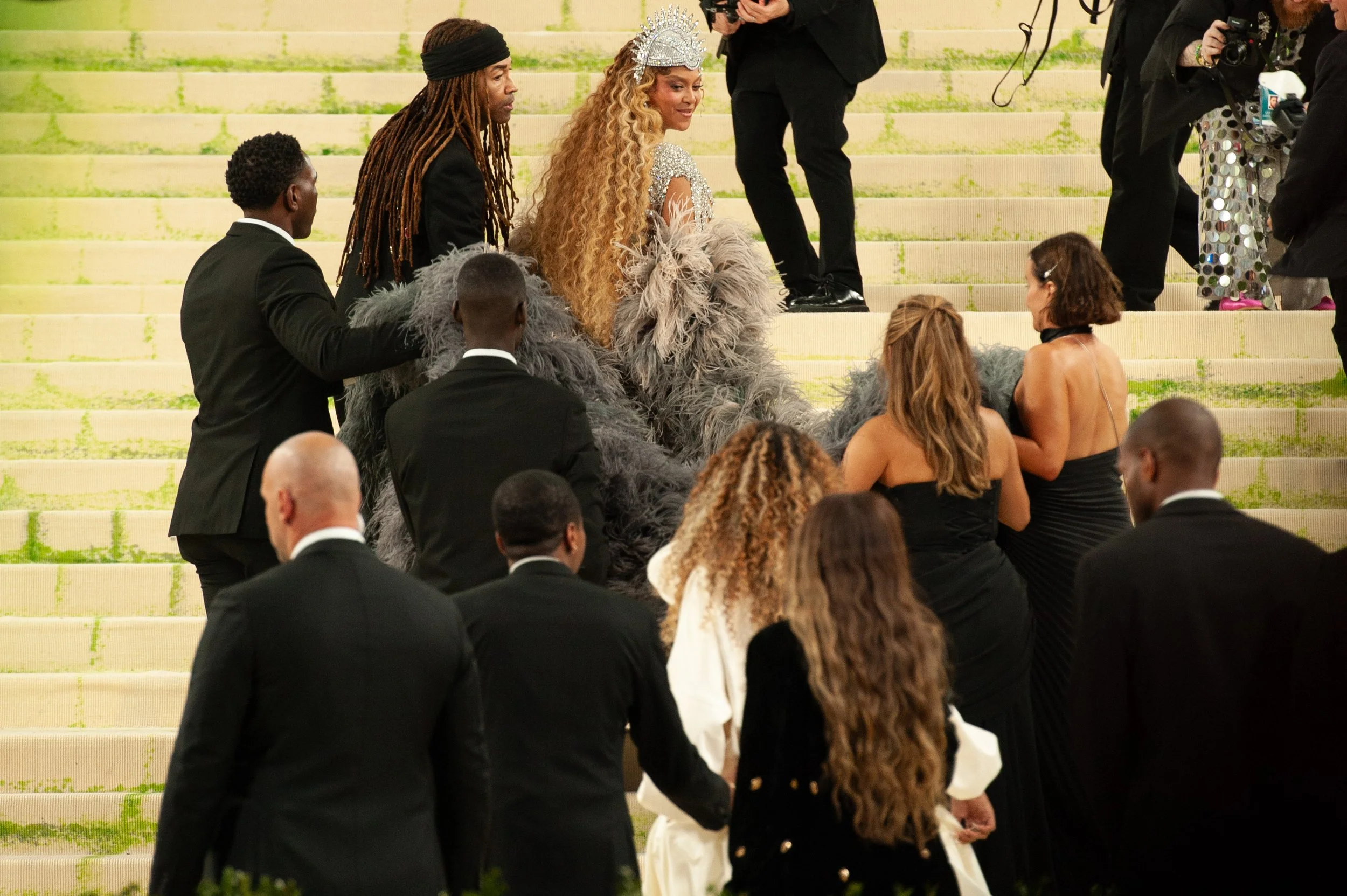
Steve Hackman brings Beethoven X Beyoncé to Calgary, with “Halo” at the heart of a musical collision built from reverence, curiosity and a serious understanding of both musical worlds.
By Kimberley Dooshima Jev
Do you understand what is happening here? Beyoncé is coming to the symphony. Okay. Beyoncé herself is not walking into the Jack Singer Concert Hall. Everybody calm down.
Her music is.
Beyoncé.
“Halo.” “Crazy in Love.” “Single Ladies.” “Texas Hold ’Em.” Music people know in their bodies before they ever stop to think about how it was built.
On Saturday, October 3, composer and conductor Steve Hackman brings Beethoven X Beyoncé to the Calgary Philharmonic for one night at the Jack Singer Concert Hall. Beyoncé’s music is woven through Beethoven’s Seventh Symphony, performed by the Calgary Phil with three vocalists and a band.
Hello? Calgary should be raving about this. This is not a pops concert with an orchestra playing some Beyoncé covers.
It is not Beethoven with “Halo” dropped on top. Hackman has built an entire musical practice around finding relationships between works that, on the surface, should have nothing to do with each other.
Which raises the obvious question.
Who is this guy, and why does he get to touch Beethoven and Queen Mother Beyoncé?
Steve Hackman - Beethoven X. Beyoncé
First of all, Steve Hackman knows what he is doing
Hackman is a composer, conductor, producer, arranger, pianist, songwriter and DJ. That last part is not decorative. Neither are the others.
His undergraduate degree is in piano performance from the University of Illinois. He later studied conducting at the Curtis Institute of Music, where he earned an advanced diploma and also studied counterpoint, composition and improvisation. He went on to study conducting with David Zinman at the American Academy of Conducting at Aspen and orchestration with composer and Broadway orchestrator William Brohn. Curtis lists Hackman as a 2004 conducting graduate.
So no, this is not some guy who woke up, had an epiphany and decided it might be fun to play around with Beethoven.
Hackman speaks the language. Several of them, actually.
His orchestral works, which he calls SYMPHONYFUSE, have included Brahms X Radiohead and The Resurrection Mixtape, which places Mahler’s Resurrection Symphony in conversation with the music of The Notorious B.I.G. and Tupac Shakur. He has conducted his work with orchestras across the United States, including ensembles in Philadelphia, San Francisco, Seattle, Pittsburgh and Boston. The Indianapolis Symphony Orchestra has given the work its own home through its Uncharted Series, curated by Hackman around classical music, pop, rock, rap and other contemporary forms.
He has also taught a course on reimagining classical music at Juilliard.
Calgary knows him.
Hackman has previously brought Brahms X Radiohead, Beethoven X Coldplay and Tchaikovsky X Drake to the Calgary Philharmonic. In our interview, he thought his first Calgary appearance may have been Brahms X Radiohead around 2018 or 2019. I think I was there.
Which makes sense, because this is also how my brain works.
I am a journalist, yes. I am also a DJ. I understand the moment when you hear two pieces of music that appear to have absolutely no business beside each other and suddenly hear the door between them.
I can DJ country into dubstep because I can hear where the music can turn.
Hackman is doing something far more structurally complicated with an orchestra, but I understand the instinct. When I asked him where these combinations begin, his answer sounded familiar.
“With each one of these fusions, there’s some sort of revelatory moment that just kind of occurs in my subconscious,” Hackman said. “A connection is made and then all of a sudden, you know, this seed is planted.”
For Beethoven X Beyoncé, that seed was “Halo.”
It started with “Halo”
Hackman hears “Halo” as more than a love song. He described it as a song about “the things in our life that save us.”
“Obviously, it’s a love song,” he said, “but one could easily extrapolate that idea and broaden it. It could be a religion. It could be a friendship. It could be music. It could be art. It could be nature. Those are the other things that save us.”
Then he heard Beethoven.
“In that moment, I realized, oh my gosh, ‘Halo’ could be fused with this second movement,” Hackman said. “Because the second movement begins so sorrowfully and mournfully. It’s painfully beautiful. But then some of the most heavenly music Beethoven ever wrote emerges from that.”
Hackman hears Beethoven’s own struggles inside the movement.
“To me, that easily could represent Beethoven struggling with his deafness, struggling with his interpersonal relationships and the collapse of him being able to just relate to his fellow man.”
“That was the first idea,” he said. “That then led the way.”
Now.
Before we started the interview, I told Hackman about Afros in tha City. I told him that this platform, this publication was co-founded with my partner, Steven Douglas Howe, an Indigenous Canadian man who passed away in 2015.
SDH loved Beyoncé. His birthday is October 1. It has been 11 gruelling years seeing many of his curiosities which led to Afros in tha City take place before my eyes, a decade and some later.
Then Hackman starts talking to me about “Halo.” A song about love. A song about the things in our lives that save us.
Okay then. Let’s go.
Sometimes life is not subtle.
He knew “Halo.” Beyoncé was the discovery.
I asked Hackman whether taking “Halo” apart had revealed anything new about Beyoncé. Not really. He already knew the song.
“I knew the song so well, and I love the song so much,” Hackman said. “As a songwriter, I’ve studied it. I’ve picked it apart.”
The larger project was different. “I certainly came to new revelations about Beyoncé in the writing of the piece,” he said.
Writing it pushed him further into research. Then came one of my favourite things he said during the entire interview.
“I was sort of blown away at every turn by what I was learning about Beyoncé.”
Hackman already understood her stature. Then he went deeper. “I did a deep dive,” he said. “I was reading and was watching and was listening.”
“I’m grateful for that journey.”
That matters. Beyoncé is so famous that it becomes remarkably easy to stop looking. The spectacle is enormous. The tours are enormous. The clothes. The dancing. The celebrity. The discourse. The arguments. The fandom. Meanwhile, the musician has been standing there the entire time. Hackman had to study that musician because this work cannot function if one side of the equation is treated as musically serious and the other is treated as material.
Beyoncé is not the seasoning on Beethoven. She is half the conversation.
“It’s just a Beyoncé album.”
Naturally, we got to Cowboy Carter (my least favourite Beyoncé album! I know it shocked me too.) I wanted to know what Hackman thought people had missed about Beyoncé’s musical intelligence during all the conversation around the album.
He slightly resisted my premise, then went somewhere more interesting. Some listeners, he said, seemed to carry an expectation that Beyoncé remain in genres they already associated with her. “Maybe casual fans, maybe not the devout,” Hackman said, “who evidently had some expectation or maybe mandate that she stay in certain genres that they approve of that she’s already been in.”
Then country arrived. “They just decide, ‘Oh, country. Country’s a bridge too far.’” Hackman did not hear the album that way.
“There’s brilliance here because it’s not a country album, of course,” he said. “It draws upon the vernacular of country music occasionally.”
He loved the audacity of the project, including the decision to call it Cowboy Carter. “I absolutely love an artist saying, ‘I could care less,’” he said. His conclusion was simpler. What were people missing? “They mistakenly thought it was a country album when really, it’s just a Beyoncé album.”
Exactly. The genres serve Beyoncé. Beyoncé does not serve the genres. Hackman encounters a version of that same resistance in his own work. What does Kendrick Lamar have to do with classical music? What does Beyoncé have to do with Beethoven?
“Of course,” he said when I asked whether that skepticism follows these productions. “This is by design, because I know that stigma exists. I know that people have a hard time conceiving of what these things have to do with one another.”
“I understand the leap that people have to take.”
That leap is also the point. “That’s what’s fascinating about this,” Hackman said. “I think that’s what can lead to some new understanding or new connections or new open-mindedness.”
He regularly encounters people who arrive unsure. “I hear it all the time from people that either say, ‘Boy, I didn’t know what this was going to be.’”
He gets it. “I would probably feel the same.”
I do not need Beyoncé brought into the symphony to prove that she belongs there.
She already belongs anywhere serious music is being discussed.
What interests me is what becomes audible when somebody understands both musical languages well enough to move the walls between them.
Take the museum glass off
That does not mean Hackman approaches the music casually. Quite the opposite. I asked whether there were parts of Beethoven or Beyoncé that felt untouchable.
“The first instinct is always: we can’t touch this,” he said.
“There’s no way to accomplish what I’m trying to do without a deep reverent love for this work.” That reverence presents its own problem. If you love the original, why mess with it? “Along with that comes the acknowledgement that it is perfect as it is,” Hackman said. “Therefore, why create a different version? Why tinker with it?” Then he answered himself.
“There’s a long tradition of artists interpolating other works, doing reimaginings of other works,” he said.
That happens constantly in contemporary music through remixes, collaborations and mashups. Classical composers did it too.
Hackman pointed to Brahms writing variations on Haydn and Bach incorporating Lutheran hymns into his music. He eventually allows himself to channel what he called “that imaginative, adventurous spirit.”
Then came another line I loved.
“Sort of delicately take the museum glass off and say, okay, here we go.”
His version is not there to replace Beethoven. It is not there to replace Beyoncé. “My version is not supplanting the original,” he said. “It exists simply as a tribute to both.” That tells me more about this project than calling it a mashup ever could.
Hackman is not asking what he can take from these artists. He is asking what happens when he listens closely enough to hear them answer one another.
The audience is part of the music
At one point in our conversation, Hackman stopped himself and returned to something I had asked several questions earlier. That interested me. I had been talking about the concert hall itself. Because the Calgary Philharmonic has an audience.
It has a community. It has traditions. It has rules. Hackman wanted to return specifically to those rules, this is just historical standard and not unique to the Phil. Every room has rules.
“The rules of etiquette for the concertgoer, they are not reflective of how classical music concerts were in the beginning,” he said.
He pointed to the first performance of Beethoven’s Seventh Symphony. According to Hackman, the second movement was so well received that it was immediately played again.
“They wouldn’t stop clapping until they played it again. That’s the energy that I’m interested in,” he said. “The dynamic between orchestra and audience.”
Beethoven X Beyoncé produces more of it.
“We get audience members who are unabashed with their joy and their celebratory spirit and their reaction,” Hackman said.
“And it’s unbelievably refreshing.”
I love that.
Maybe the question is not how to teach new people the rules of the symphony. Maybe some of the symphony’s rules could use a little Beyoncé.

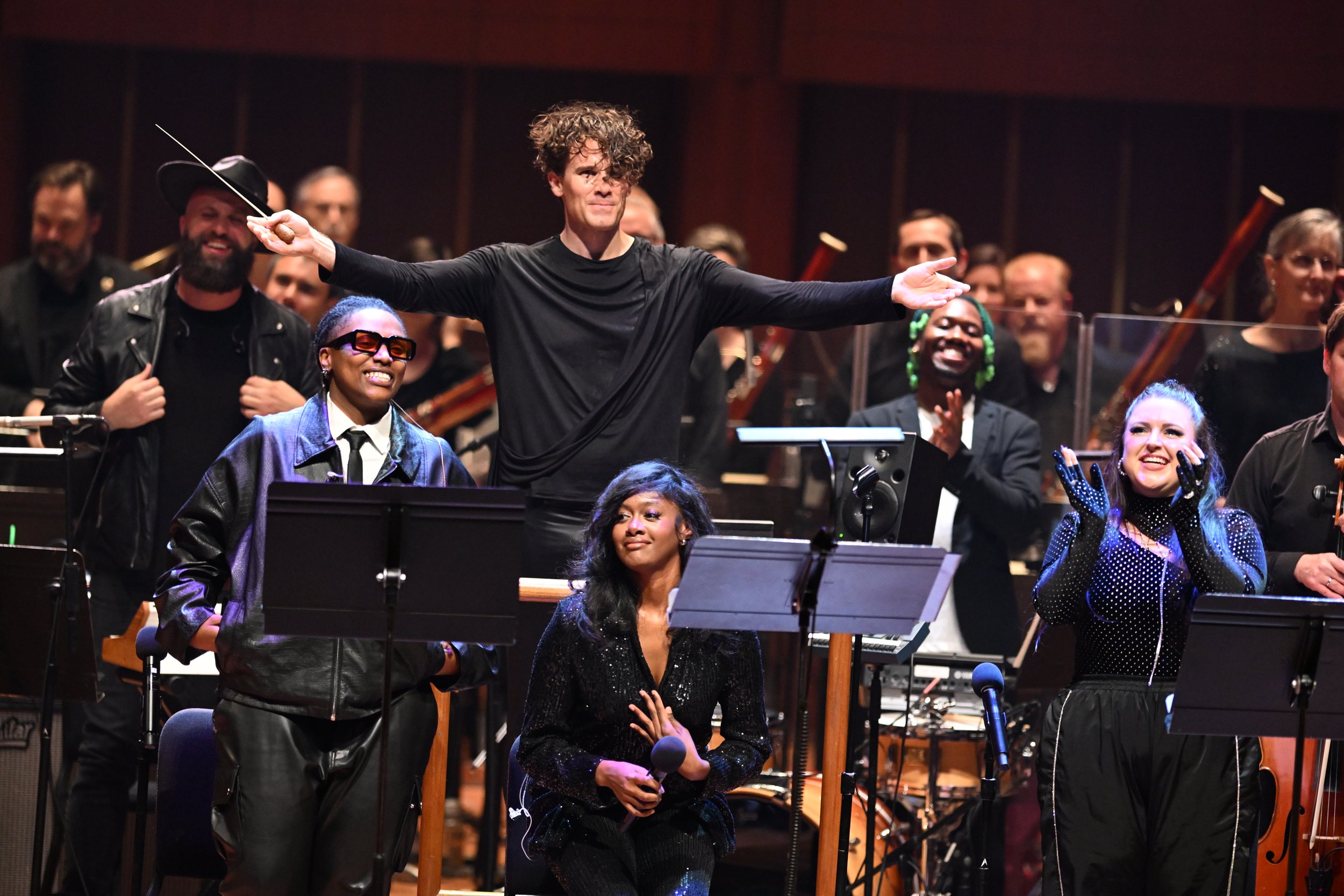
Steve Hackman's Beethoven X Beyonce vocalists Brayla, Brooke Simpson, and Malia Civetz. Credit: Alex Markow.
Calgary, do you know this is happening?
One of my first questions to Hackman was very simple.
Who is Beyoncé’s audience?
“I mean, Beyoncé has a massive audience,” he said. “A massive multigenerational audience, a massive multi-ethnic, multiracial, multi-identification audience. So, it’s all of them.”
True.
Geography still matters. I saw Beyoncé open her I Am... World Tour at Edmonton’s Rexall Place in 2009. The room was nowhere near full. I have never forgotten it. This is Beyoncé we are talking about. So I asked Hackman whether geography and local culture change who actually feels connected to an artist, even one operating at Beyoncé’s scale.
He said yes.
In communities where an audience may be more disconnected or removed, Hackman said, sometimes that very distance can galvanize people.
“Let’s band together,” he said. “Let’s stand for this. Let’s be proud about this. Let’s listen to this. Let’s spread the word.”
For some audiences, these productions become an opportunity “to come out and to celebrate and to participate.” Hackman has had people approach him after performances and thank him. “Thank you for making us feel heard and seen,” he recalled.
People told him they never imagined hearing the music they loved performed by their local orchestra. “That is something that is extremely fulfilling for me,” Hackman said. “I don’t take it for granted. And it’s a great privilege.”
So naturally, I pushed the question one step further. Are orchestras expecting Beyoncé to bring audiences to them, or are orchestras doing the work to go out and meet Beyoncé’s audiences?
Hackman answered from the perspective of his own work. “By design, I’m wanting to meet audiences where they are,” he said. “That’s what we have to do.”
Meaningful community engagement, he said, requires more than programming.
“You have to listen to them. We have to learn about them. We have to know about them. We have to understand who they are. And again, meet them where they are.”
Hackman sees Calgary Philharmonic bringing the production here as evidence of an intention to do that. He also does not pretend one concert completes the job.
“It’s a small thing,” he said. “We have to do so much more. But it’s one thing I’m doing.”
There it is.
Who checks the blind spots?
That question of responsibility stayed with me. Hackman is moving between musical traditions, artists, audiences and communities. So I asked him directly: Who checks your blind spots?
“Number one, the audience,” he said. “Because that’s where you get the real feedback when you’re in the room, to see if it’s working.” Then come conversations. Messages. People telling him what they heard. “Number two, the artists and my colleagues, especially the soloists,” he said. The vocalists and musicians joining him are not incidental to the production.
“They’re integral to the success of this, and they help me check blind spots.” Then came the orchestra. Hackman paused there.
“If I adjusted course based on the reaction of the orchestral musicians in the beginning, or even, let’s say, for the first five, six years of this, this would have ceased to exist.”
“So I had to push through,” he said. “And endure that, frankly. That just took time and just took education.” That answer matters because genre does not only exist in music. It exists in institutions. It exists in training. It exists in what musicians are told is serious. It exists in what audiences are told belongs in which room.
Hackman has spent years pushing against those divisions without pretending they are not there. For Beethoven X Beyoncé, he is bringing three vocalists because one voice cannot reasonably represent Beyoncé.
“I feel like each represents a different side of Beyoncé,” he said. “She’s such an incredibly versatile singer and artist that you need multiple people to try to represent all of who she is.” The singers, he said, are accomplished artists themselves.
“They bring such joy.” Calgary’s performance features vocalists Brayla Cook, Malia Civetz and Brooke Simpson, with Jalyn Spencer on bass and Brenton TaRon Lockett on drums alongside the Calgary Philharmonic.
Good. Nobody needs to come onstage and impersonate Beyoncé. We already have Beyoncé. Interpretation is much more interesting.
Beyoncé’s camp originally said no
Of course I asked whether Beyoncé has heard any of this. Hackman does not have a personal response from her. He does have permission to perform the work. Getting there was interesting.
Hackman explained that artists at this level receive an enormous number of requests. Those requests move through teams whose job includes protecting the artist. “An artist has never said no,” he clarified when I asked whether anyone had rejected one of his projects. “But it’s camps that are being protected that don’t know what this is.”
From the outside, his request can arrive with “no context” and “no artistry behind it.” It can look like one more thing that needs to be declined. “Understandably, artists like this and camps like this get a lot of requests,” he said.
Then:
“Beyoncé was a no at first before they knew what it actually was.”
“Absolute no.”
Once people actually understand the project, he said, the conversation becomes easier. “I don’t think it’s a hard conversation when they actually understand it. It just takes them a while to get there.” Why? “On the face, it’s hard to get how this works.”
It is also difficult, he acknowledged, for people to trust immediately that the result will not be reductive. Which brings us right back to the beginning.
You have to hear it. Hackman still wants one particular person to hear it too.
Beyoncé.
“I’m longing for it,” he said. “Nothing would give me more joy than just to be able to play this for her, tell her what the intention was and, you know, thank her for the gift of her music.” There is the whole thing.
Not Beethoven validating Beyoncé. Not Beyoncé making Beethoven cool. Not a conductor borrowing Beyoncé because she can sell tickets. A musician who has spent his life moving between musical languages hearing something in two bodies of work he loves, then doing the enormous amount of work required to make the rest of us hear it too. A thank you.
Do you understand what is happening here?
Calgary gets one night. One. Hackman likes something about that. “In Calgary, you know, it’s one night only,” he said. “There’s beauty in that. And there’s magic in that when you’ve only got one shot on it. We’re all only going to experience this this one night.”
So I am going back to where we started.
Do you understand what is happening here?
Beyoncé is coming to the symphony. “Halo” is meeting Beethoven. The orchestra gets to loosen up.The Beyoncé people get to meet the Beethoven people. The Beethoven people might hear Beyoncé differently too.
Bring the kids. Bring your friend who has never been to the symphony. Bring the person who thinks classical music has nothing to do with them. Hear what happens.
And this story is live today on October 1, 2026, 11 years after we danced our last dance. Steven Douglas Howe’s birthday. One day after Truth and Reconciliation. September 30 became the National Day for Truth and Reconciliation federally in 2021. Bill C-5 received Royal Assent on June 3, 2021, and the first federal observance was September 30, 2021.
Alberta also began formally commemorating it from that first year. Alberta Education’s 2021–22 annual report explicitly says the National Day for Truth and Reconciliation “was held for the first time on September 30, 2021,” and Alberta held a provincial commemoration that day.
He was a Beyoncé fan. SDH. The person who helped start Afros in tha City and spent his life asking questions about where all the different pieces of us were supposed to meet. Ten years since Afros made it’s debut online, I am still answering him.
This time the answer sounds like “Halo” inside Beethoven’s Seventh Symphony. A song about love. A song about the things that save us.
Happy Birthday, Steven Douglas Howe.
This one is for you.
Steve Hackman’s Beethoven X Beyoncé is at the Jack Singer Concert Hall on Saturday, October 3 at 7:30 p.m. with the Calgary Philharmonic Orchestra.