• EXPLORE AITC
  • SHOP
  • About Us
  • Masthead
  • Work
  • Contact Us
  • Standards
    • Our Philosophy
    • Diversity & Representaion
    • Editorial Standards
    • Editorial & AI Standards
    • Ethics & Corrections
    • Partnerships & Sponsorships
  • Privacy Policy
  • Terms & Conditions
  • Menu

Afros in tha City

Stories Shaping Culture
  • EXPLORE AITC
  • SHOP
  • About Us
  • Masthead
  • Work
  • Contact Us
  • Standards
    • Our Philosophy
    • Diversity & Representaion
    • Editorial Standards
    • Editorial & AI Standards
    • Ethics & Corrections
    • Partnerships & Sponsorships
  • Privacy Policy
  • Terms & Conditions

How Springboard Is Building Calgary’s Cultural Ecosystem

September 11, 2026 in Art, Contemporary Dance

For Springboard Performance artistic director Nicole Mion, Fluid Fest is not simply a collection of shows. It is part of a larger question about how artists, audiences, cities and ideas move together.

By Kimberley Dooshima Jev


Nicole Mion talks about art in terms of systems. Not simply performances, artists or venues, but the structures that allow all of those things to find one another and continue to exist.

“Good curation is about creating an ecosystem, a cultural ecosystem,” says Mion, artistic director of Springboard Performance.

It is a useful way to understand an organization that can be difficult to describe in one sentence.

Springboard operates across live performance, artist development, public space, residencies and festival programming. Fluid Fest is its annual contemporary dance and performance festival. containR creates space for public-facing cultural activity. Season Presenting brings work to Calgary throughout the year. Interrarium supports some of the development and thinking audiences may never see.

Different functions, Mion argues, belong to the same larger system. The question underneath them is consistent: “How can we impact the cultural ecosystem in Calgary and be a part of a national and international conversation around art?”

That question matters in a city that is still regularly asked to prove it has an arts community at all.

The infrastructure behind the art

Springboard began as a collective of Calgary dancers and choreographers looking for ways to create and perform their work.

The practical problem was familiar. Artists needed space. They needed administrative support. They needed audiences. They needed other artists. They needed enough activity around them for a practice to become sustainable rather than occasional. Working collectively offered one answer. Mion eventually took over the organization and began considering what Springboard could provide that individual artists could not easily build alone.

Part of that thinking came from her own experience as a dancer, filmmaker and choreographer.

“You have that enthusiasm for a few years,” she says. “But then after that, it’s like, in a place with so little infrastructure like Alberta for culture, how do you build those ecosystems and how do you find your people?”

The problem was not only making art. It was creating enough movement around the art for a community to form.

An artist might create a work every two years. An audience, however, cannot be expected to build a relationship with an entire discipline by encountering it once every two years. The critical mass has to exist around the work too.

That means developing artists while developing audiences. It means creating opportunities for work to circulate. It means putting performance in places where people may encounter it without already thinking of themselves as contemporary dance audiences.

For Mion, that can be a theatre. It can also be a gallery, a public space or a street corner. Some people, she says, will not enter a theatre regardless of how heavily a show is advertised. Put something unexpected in front of them somewhere else and the relationship changes.

The venue becomes part of the curatorial question.

Fluid Fest offers more than one way in

That philosophy is especially visible in Fluid Fest. Mion resists reducing the festival to a single definition of dance. She talks instead about the physical body and what it can communicate about being alive now.

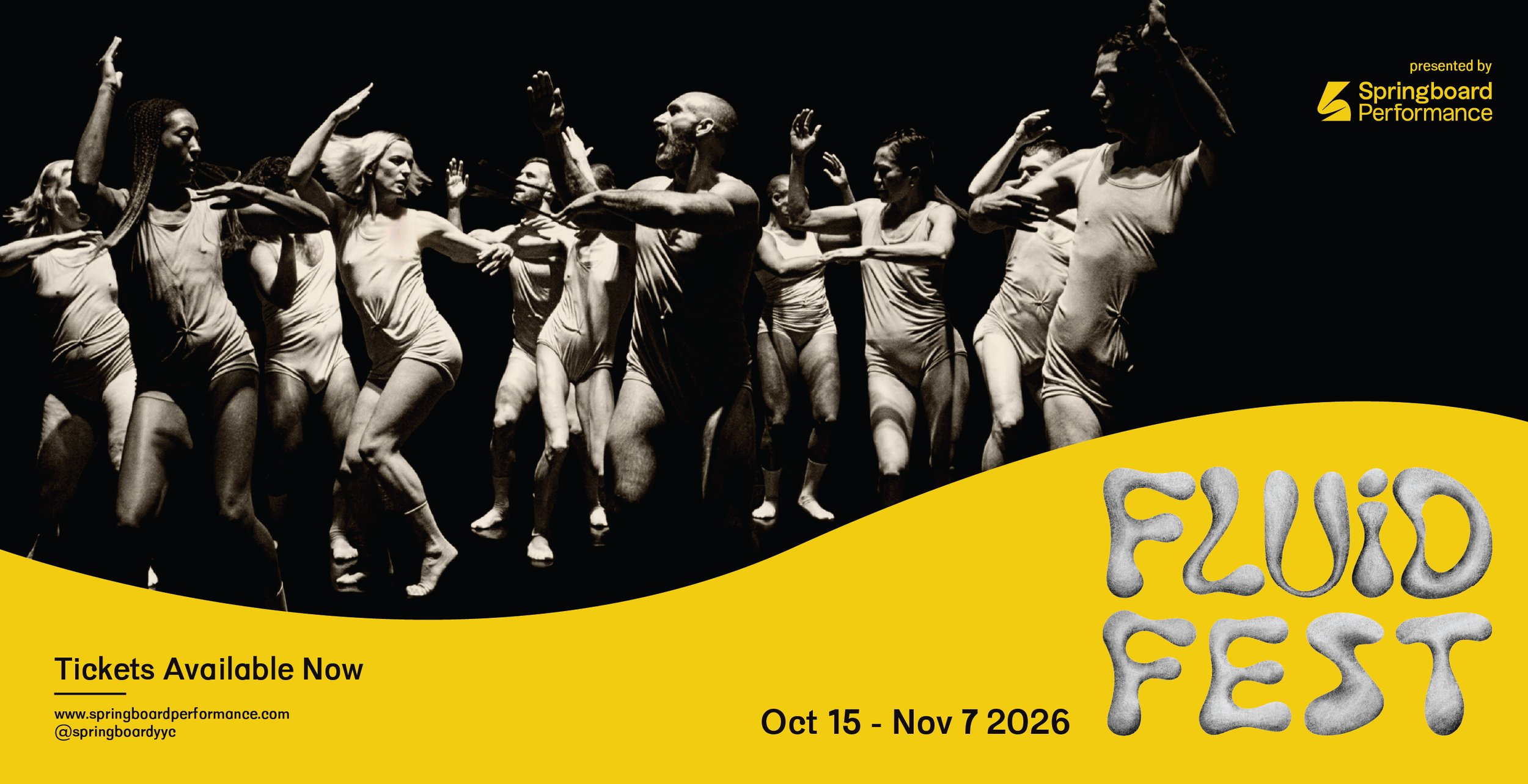
The 2026 program moves between dance, theatre, music, visual art, installation, public space and performance. For audiences unfamiliar with contemporary dance, that range is deliberate.

“It depends on who you are,” Mion says when asked what people should see.

Someone drawn to visual art may enter through Omote (面), a collaboration between dance artist Shion Skye Carter and mask maker Miya Turnbull. The work brings masks, movement and Japanese Canadian identity into the gallery environment.

Elsewhere, Alexandra “Spicey” Landé and EBNFLŌH bring Mōnad to Contemporary Calgary.

Mion describes Landé as part of a generation of artists taking street dance seriously as contemporary performance language. In Mōnad, she sees movement, theatre and psychology meeting inside a work capable of holding a wider emotional range.

Mion talks about the expectations placed on Black expression and the emotions that become acceptable or unacceptable depending on the room. A work like Mōnad can create space for something less restricted.

“What can you express in what settings?” she asks. The question moves beyond choreography.

It becomes social.

Rachel Meyer’s Mama, do we die when we sleep? enters through another door. Meyer comes from ballet, bringing its physical precision into work that Mion describes as more psychologically and visually expansive.

The setting is not decorative. It participates.

A large pile of chairs becomes part of a world concerned with imagination, relationships and the way possibility changes between childhood and adulthood.

Catherine Gaudet’s ODE works differently again, drawing bodies into collective movement and repetition. Mion describes the experience through sensation. There is something communal in it, something closer to the physical force of a marathon or the shared energy of a rave than the distant observation some audiences may associate with contemporary dance.

That physicality is important to how she thinks about the festival.

Contemporary performance can ask difficult questions without requiring an audience to arrive with an academic vocabulary for answering them.

Mion jokes about the idea that contemporary dance can sometimes feel like a kind of sushi you need training to understand.

Fluid Fest is built against that assumption.There can be experimentation without exclusion.

There can be risk without requiring the audience to already know the rules.

Calgary does not need permission to participate

There is another argument running through Mion’s programming. Calgary belongs in these conversations.

She has spent years travelling to festivals, seeing work and meeting artists elsewhere. Again and again, she encountered assumptions about what could possibly be happening in Calgary.

The absence of national visibility could easily be mistaken for the absence of activity. Mion rejects that logic. Calgary has artists. Alberta has artists. The work exists. Visibility and circulation are separate problems.

Springboard’s role, as she sees it, includes creating some of the conditions through which those artists and conversations can meet.

“I think that Calgary should have great artists from the place and that we need to be in conversation with creative thinkers of all kinds,” she says. “We’re a part of that conversation internationally, nationally, locally.”

Fluid Fest makes that idea tangible.

Artists arrive in Calgary from Montreal, Vancouver, Halifax, Toronto and elsewhere. Calgary artists appear inside the same program. Performance crosses into galleries and unconventional spaces. Partnerships pull different organizations into the same orbit.

The result pushes against the persistent idea that ambitious contemporary arts programming properly belongs somewhere else.

Toronto. Montreal. London. Amsterdam. Why not Calgary?

Mion has seen what festivals elsewhere can create. Her response is not to reproduce those cities here. It is to recognize that Calgary can participate in the same level of cultural exchange while remaining itself.

“I see the possibility,” she says. “And then I’m like, well, why not here?”

Art needs circulation

This is where the ecosystem argument becomes larger than one festival. Artists need more than opportunities to make work. They need routes through which the work can travel.

“Trade is circulation,” Mion says. The comparison is intentional.

Canada would not expect most industries to grow without networks, exchange, research, markets and movement. Mion questions why art should be treated differently.

Local creation matters, but remaining permanently local can make sustained artistic careers difficult. Artists need to encounter audiences elsewhere. Presenters need to see work. Ideas need to move between cities. Relationships have to form across regions and borders.

Culture has its own trade routes.Those routes also shape how a place understands itself.

For Calgary, participation in national and international artistic circulation challenges an old narrative that meaningful cultural innovation always arrives from somewhere else.

Springboard is interested in a different proposition.

The city can receive work. It can generate work. It can host conversations. It can send artists outward. It can become a meeting point. None of that requires pretending Calgary is Toronto or Montreal.

It requires recognizing what already exists here and building the infrastructure that allows it to connect.

Sensation, curiosity and community

For all the systems thinking surrounding Springboard, Mion eventually brings the conversation back to something very simple. People gather. They experience something together and then they talk about it.

A festival can create conditions for that exchange in ways an isolated performance cannot. One event leads into another. An audience encounters an artist and then stays for music. Someone arrives for visual art and leaves having watched contemporary dance. People who may not normally occupy the same cultural spaces find themselves sharing a room.

The experience keeps unfolding.

For Mion, that physical act of being together matters at a moment when so much cultural life is mediated through individual screens.

“You have a visceral experience of being in community, not just on your computer,” she says.

The conversation after a performance matters too. The confusion, excitement, disagreement and recognition are part of what happened.

Fluid Fest does not need every audience member to understand every piece in the same way.

It’s asking them to enter so they can encounter something. Fluid Fest is asking its audience to remain curious. That may be the clearest expression of what Springboard has spent decades trying to build.

Not simply an organization that presents art, but a structure through which artists, ideas, audiences and places can continue finding one another.

A cultural ecosystem built from sensation, curiosity and community.
Tags: Springboard, Fluid Fest
Prev / Next
No results found


Stories
  • September 2026
  • August 2026
  • July 2026
  • June 2026
  • May 2026
  • April 2026
  • March 2026
  • February 2026
  • January 2026
  • July 2024
  • June 2024
  • May 2024
  • April 2024
  • March 2024
  • February 2024
  • January 2024
  • December 2023
  • November 2023
  • October 2023
  • September 2023
  • August 2023
  • July 2023
  • June 2023
  • May 2023
  • March 2023
  • January 2023
  • December 2022
  • November 2022
  • October 2022
  • July 2022
  • June 2022
  • May 2022
  • April 2022
  • March 2022
  • February 2022
  • January 2022
  • December 2021
  • November 2021
  • October 2021
  • September 2021
  • August 2021
  • July 2021
  • June 2021
  • May 2021
  • April 2021
  • March 2021
  • February 2021
  • January 2021
  • November 2020
  • October 2020

AITC - September 2026

Featured
Cover (1).png
AITC September 2026 - What Will It Take For Us To Feed One Another - Aquakultre

COVER STORY PREVIEW

Through 1783 and Matriarchs, Aquakultre is transforming family memory into a living archive while asking Black Nova Scotian communities to remember how deeply they belong to one another.

By Kimberley Dooshima Jev

Lance Sampson was standing in front of a video kiosk at the Africville Museum when a familiar name appeared on the screen. The woman speaking was his great-great-grandmother. Sampson had stumbled onto what he understands to be the only surviving recording of her voice.

His first instinct was reverence. His second was hip-hop.

“I immediately went into hip-hop mode,” he remembers. “Let me sample this right quick.”

That impulse sits at the centre of Sampson’s work as Aquakultre: find what remains, listen closely, then give it somewhere new to live.

Read the full cover story

Aquakultre covers the September 2026 issue of Afros in tha City. The complete story explores 1783, Matriarchs, the family histories behind the work and the moment Lance Sampson found his voice.

The full feature and photo story will be released with the September digital issue and limited print edition.

Join the Afros in tha City newsletter to be the first to know when both editions become available.

Read more →
How Springboard Is Building Calgary’s Cultural Ecosystem
Art, Contemporary Dance
How Springboard Is Building Calgary’s Cultural Ecosystem
Art, Contemporary Dance

Dance, public space, galleries and live performance become part of the same conversation when Springboard Performance asks what a cultural ecosystem can look like.

Through Fluid Fest and its wider programming, artistic director Nicole Mion is building connections between artists, audiences and ideas in Calgary while placing the city within national and international conversations about contemporary performance.

In How Springboard Is Building Calgary’s Cultural Ecosystem, Afros in tha City looks at the systems behind the art, the importance of circulation and the artists using movement, theatre, music and visual art to create new ways into performance.

The full feature and photo story will be released with the September digital issue and limited print edition.

Join the Afros in tha City newsletter to be the first to know when both editions become available.

Read more →
Art, Contemporary Dance
What Sugar and Indigo Remember

Sugar, indigo, family photographs and the Atlantic carry histories that are easy to overlook until someone asks us to look again.

At Dalhousie Art Gallery, curator francesca ekwuyasi brings together Stina Baudin, Adama Delphine Fawundu, Bushra Junaid and Christina Leslie for Burnt Sugar Blue, an exhibition examining colonialism, Black diasporic memory, family, spirituality and the histories embedded in everyday materials.

In What Sugar and Indigo Remember, Afros in tha City looks at how these artists turn materials and archives into something living, while Roger Mooking’s SoundBites continues the conversation from across the gallery.

The full feature and photo story will be released with the September digital issue and limited print edition.

Join the Afros in tha City newsletter to be the first to know when both editions become available.

Read more →
Roger Mooking Is Building Beyond the Algorithm

Roger Mooking is thinking beyond the algorithm.

With SoundBites, the Canadian multidisciplinary artist is responding to streaming culture, shrinking attention spans and the rise of AI by asking a different question: what happens when technology distributes the work, but does not define its value?

In conversation with Afros in tha City, Mooking talks about the state of the music industry, the value of slow creative practice and why the future of music may look a lot more like a campfire than a platform.

The full feature and photo story will be released with the September digital issue and limited print edition.

Join the Afros in tha City newsletter to be the first to know when both editions become available.

Read more →
Alberta Doesn’t Have a Talent Problem. It Has an Access Problem.
Film
Alberta Doesn’t Have a Talent Problem. It Has an Access Problem.
Film

Talent, ambition and strong ideas are not always enough when the people with the power to finance, develop and distribute them are somewhere else.

At the inaugural TIFF: The Market, Creatives Empowered brings Alberta creators Sandra Bueckert, Tobit Luyeye Lemba and Flordeliza Dayrit into conversations with producers, buyers, distributors and other industry decision-makers from around the world.

In Alberta Doesn’t Have a Talent Problem. It Has an Access Problem., Afros in tha City looks at what meaningful industry access can mean for creators working outside Canada’s largest production centres, and why visibility only matters if the conversation continues after the festival.

The full web exclusive is available now on Afros in tha City.

Read more →
Film
Prismatic Is Thinking Beyond Representation

Prismatic Arts Festival has spent nearly two decades creating space for Indigenous, Black and racialized artists. For Executive and Artistic Director Raeesa Lalani, the conversation now goes beyond visibility to sustainability, power and what artists need to build lasting careers.

In our September 2026 issue, Afros in tha City looks at the festival’s history, its place in Canada’s arts ecosystem and the artists shaping Prismatic 2026, including Walter Borden, Tara Taylor, Bageshree Vaze, Tania El Khoury and Dee Hernandez.

The full feature and photo story will be released with the September digital issue and limited print edition.

Join the Afros in tha City newsletter to be the first to know when both editions become available.

Read more →
Timeless: 100 Years of Oscar Peterson Extended at Studio Bell

The National Music Centre’s Timeless: 100 Years of Oscar Peterson has been extended at Studio Bell through January 3, 2027. Originally opened in July 2025 to commemorate the centenary of Peterson’s birth, the exhibition brings together instruments, archival materials, awards, personal artifacts, interviews and multimedia installations to tell the story of one of Canada’s most important musicians.

Read more →
Saul Williams Still Believes Art Has a Job to Do

With Leap Life and Songs My Mother Taught Me arriving eleven days apart, Saul Williams turns sound and page into one argument about art, memory and responsibility.

There is something almost unreasonable about the amount Saul Williams still expects from art. Nearly three decades into a career spanning poetry, music, theatre, film and literature, Williams has not arrived at the comfortable conclusion that art should simply entertain us. Within the span of eleven days this summer, he released two projects arguing that culture does much more than that.

His album Leap Life, released August 28 on Big Dada, moves through spoken word, hip-hop, jazz, ambient composition, African rhythmic traditions and improvisation.

On September 8, Haymarket Books published Songs My Mother Taught Me: Why the Artist Must Take Sides, a political memoir tracing the people and experiences that shaped Williams’ understanding of art as power.

The full feature and photo story will be released with the September digital issue and limited print edition.

Join the Afros in tha City newsletter to be the first to know when both editions become available.

Read more →
Afros Picks: Three DJs Setting the Tone at MUSE N°001

Vancouver’s MUSE N°001 brings together four DJs with distinctly different approaches to the dance floor. RAEDIAMENDZ, SAANZ, DJ DES and DJ BOMBAE move through hip-hop, R&B, African electronic music, Afro House and open-format sounds, each bringing her own relationship to culture, rhythm and the room.

Created by creative director Drew Ragiste, MUSE is built around a bigger question: what happens when women are considered in the design of nightlife from the beginning?

In this month’s Afropicks, Afros in tha City meets the four selectors setting the tone for MUSE’s first night.

The full feature and photo story will be released with the September digital issue and limited print edition.

Join the Afros in tha City newsletter to be the first to know when both editions become available.

Read more →
This Is What Calgary Sounds Like Now
Award Shows, Music
This Is What Calgary Sounds Like Now
Award Shows, Music

Bijaan and Jaiden Riley arrive at the 2026 YYC Music Awards from very different corners of Calgary’s music community. Bijaan’s path runs from childhood rap sessions in northwest Calgary to two nominations for “Jungle,” while Riley enters with three nominations after a year shaped by rapid career growth, community and profound personal loss.

In conversation with Afros in tha City, both artists look beyond the awards to the friendships, mentors, family histories and years of work that made the nominations possible.

From Bijaan’s third-culture story and long relationship with Calgary hip-hop to Riley’s rise through the city’s country and folk community, the feature offers a deeper look at what it actually takes to build a music career from here.

The full feature and photo story will be released with the September digital issue and limited print edition.

Join the Afros in tha City newsletter to be the first to know when both editions become available.

Read more →
Award Shows, Music
Recovery Was Never Meant to Be Hidden
Fashion, Wellness
Recovery Was Never Meant to Be Hidden
Fashion, Wellness

Sober Runway is bigger than a fashion show. Built from lived experience, work in addiction and mental-health services, and belief in recovery through community, the organization uses fashion to challenge the idea that surviving addiction should remain hidden.

In the September issue, Sober Runway founder Suzzy, opens up about stigma, culture, family, recovery and the community she is working to build beyond the runway.

The full feature and photo story will be released with the September digital issue and limited print edition.

Join the Afros in tha City newsletter to be the first to know when both editions become available.

Read more →
Fashion, Wellness
The Road They Built and the Stars Who Found Their Way Home
Music
The Road They Built and the Stars Who Found Their Way Home
Music

There was a time when Kreesha Turner’s voice was everywhere. Her music filled Canadian radio, reached international audiences and made her one of the most recognizable artists to emerge from Western Canada. Then she stepped away.

Her return to Edmonton leads back to Music for Mavericks, the grassroots collective that helped prepare Kreesha, Mouraine and a generation of Alberta artists for the world.

Twenty years later, they reflect on the music, sacrifice and community behind the movement, as well as the work Alberta still has left to do.

*Community Note
In connection with this feature, a direct donation was made to the Calgary Drop-In Centre by Music for Mavericks.

The full feature and photo story will be released with the September digital issue and limited print edition.

Join the Afros in tha City newsletter to be the first to know when both editions become available.

Read more →
Music
Afros in tha City - August 2026 - Adrian Younge
Identity, Music
Afros in tha City - August 2026 - Adrian Younge
Identity, Music

& Afro-Disco Makossa: The Dance Floor Record He’s Always Wanted to Spin & More.

Music never arrives without a history. It carries places, technologies, memories and the fingerprints of those who came before.

For our August cover story, Afros in tha City sits down with Adrian Younge to explore the sounds, relationships and creative philosophy behind Afro-Disco Makossa—a record born from his long-held desire to create music for the dance floor without surrendering the depth, musicianship or historical consciousness that defines his work.

Drawing from makossa, soul, funk and disco, the album does not treat these traditions as relics to be reproduced. Younge approaches them as living languages: sounds capable of holding their histories while continuing to move, transform and speak to the present. The result is music designed for movement, connection and deep listening—a record that looks backward only to understand where it might travel next.

But this conversation extends far beyond one album.

Younge reflects on the trust that can only be built through consistency, his enduring creative partnership with Ali Shaheed Muhammad, and the ecosystem they have created through Jazz Is Dead. Rather than positioning legendary musicians as figures frozen in the past, the platform invites living artists to continue creating, experimenting and adding new chapters to their own stories.

He also speaks about attending law school because he wanted to become what he calls “an educated artist”—someone equipped to understand contracts, intellectual property, ownership and the structures surrounding the work. His independence is not simply an aesthetic or an industry label. It is knowledge, preparation, discipline and the infrastructure required to protect a creative life.

That philosophy carries particular weight for an independent publication like ours. Building outside traditional systems requires more than vision. It requires learning how the machinery works, deciding what must remain yours and creating an ecosystem capable of supporting the work long after the excitement of an idea has passed.

Throughout the conversation, Younge retains the curiosity that first led him toward music. “We’re just bigger kids,” he says—a reminder that serious artistic practice does not require abandoning wonder. Growth can mean becoming more skilled, more informed and more intentional while remaining open enough to keep discovering.

This is a cover story about a dance-floor record, but it is also about something larger: how artists honour history without becoming trapped inside it, how independence is built rather than declared, and how curiosity keeps the conversation moving forward.

Adrian Younge covers the August issue of Afros in tha City.

Read “Afro-Disco Makossa: The Dance Floor Record He’s Always Wanted to Spin” at afrosinthacity.com and in our print publication.

Stories Shaping Culture.

Read more →
Identity, Music
Valerie June on the Practice of Joy
Music
Valerie June on the Practice of Joy
Music

A fifteen-minute festival interview with Valerie June begins with crossed schedules and a quiet moment of evaluation. Then the conversation finds its rhythm, becoming something much larger than an exchange about her latest album, Owls, Omens and Oracles.

In “The Practice of Joy,” Kimberley Dooshima Jev speaks with the Grammy-nominated artist about spirituality, independence and building a creative life that remains aligned with your values. June shares how meditation and affirmations become part of ordinary routines, why “small is powerful,” and how she measures the impact of her music through human connection rather than charts, algorithms or scale.

Their conversation also turns toward the ways Black women’s experiences are routinely flattened—and the freedom of creating new platforms instead of waiting for permission to belong. June’s declaration, “I’m keeping my joy because they would want me to,” transforms joy from a fleeting emotion into remembrance, responsibility and an inheritance carried forward.

What begins as an interview about music ultimately clarifies the values guiding Afros in tha City: community over scale, creation over permission and resonance over metrics. It is a reminder that joy is not escapism. It is a deliberate practice—and sometimes, an act of survival.

Read “The Practice of Joy” in full at Afros in tha City or in our print publication.

Read more →
Music
Lowkita - In Her Own Time
Music
Lowkita - In Her Own Time
Music

After nearly a decade between full-length projects, Lowkita returns with Why(Te) Tee—a deeply personal record shaped by motherhood, grief, burnout and the quiet confidence of an artist moving in her own time.

In “In Her Own Time,” Kimberley Dooshima Jev traces the Calgary-born, Vancouver-based artist’s years of rebuilding. Lowkita never stopped creating: she performed, produced, DJed, designed clothing and found new ways to sustain herself while raising her daughter and navigating profound personal loss.

The story also explores the meaning behind Why(Te) Tee. What began with the image of a white T-shirt as a symbol of starting over evolved into a larger meditation on purpose: the “Why” behind continuing, “TE” as a reminder that timing is everything, and the belief that every pause and setback has helped build the project’s foundation.

More than a comeback, Why(Te) Tee is an invitation to meet the person behind Lowkita’s bright, energetic presence. It captures an all-around artist who has learned that consistency does not require constant visibility—and that showing up, on your own terms, can be its own form of success.

Read “In Her Own Time” in full at Afros in tha City or in our print publication.

Read more →
Music

July 2026 - The Omnibus - Print July 2026 - The Omnibus - Print
Sold Out
July 2026 - The Omnibus - Print
CA$50.00

The Summer Omnibus is our most ambitious issue yet. Bringing together seven months of journalism, photography, and storytelling, this special collector's edition celebrates Black arts, business, fashion, music, and community across Canada and the diaspora.

Featuring exclusive cover stories with Judith Demosthene, Funmi Osatuyi, Adrianne Williams, Nancy Nixon, Ayokunle Akinsebikan, Femi Jr., and more, this 70-page volume captures the people, ideas, and conversations shaping culture today.

Beautifully printed in limited quantities, the Summer Omnibus is designed to be collected, shared, and revisited long after publication.

Limited print copies available.


“It always seems impossible until it’s done.”
— Nelson Mandela


Promotional image of a woman suspended in the air with hand placed above a deluxe jar of DTouch quiet gravity mineral salts


© 2026 Afros in tha City