
By Peter Jev
A Childhood Defined by Curiosity
Dotun Popoola was four years old when he first started experimenting with colour and texture, and nine when his father, recognising the seriousness underneath what looked like a child's restlessness, enrolled him in a local art studio for an apprenticeship.
By then, the boy had already developed a reputation in his neighbourhood for scratching patterns into cars and drawing on walls—behaviour that gets most children scolded and, occasionally, if the adults around them are paying close attention, redirected into something else entirely.
It is worth sitting with that detail for a moment because it contains the entire shape of what Popoola would eventually become: someone whose instinct, even as a small child, was to mark surfaces other people had already decided were finished. A car door was not a car door to him. It was a blank space waiting for intention.
Born in April 1981 in Agege, Lagos, Popoola grew up surrounded by mechanical workshops and discarded urban debris. Rather than seeing waste, he saw possibility. That perspective became the foundation of an extraordinary artistic career.
Academic Excellence Behind the Artist
While Popoola's sculptures often dominate conversations in the media, his academic achievements deserve equal recognition.
He earned a National Diploma in Painting and General Arts from Auchi Polytechnic in 2004, graduating as the institution's best student. Four years later he graduated as the overall best student in Fine and Applied Arts (Sculpture) from Obafemi Awolowo University before returning in 2014 to complete a Master of Fine Arts in Painting.
This background explains much of what makes his sculptures distinctive. Although he works primarily with steel, he thinks like a painter. He is careful, considers the silhouette, composition, negative space and how each structure reads from a distance.
Learning Abroad, Creating Something Entirely New
A pivotal chapter in Popoola's journey took him thousands of kilometres from Lagos to Lemmon, South Dakota.
At the John Lopez Studio, he trained under renowned American sculptor John Lopez, mastering MIG welding and plasma cutting—industrial techniques essential for producing monumental sculptures.
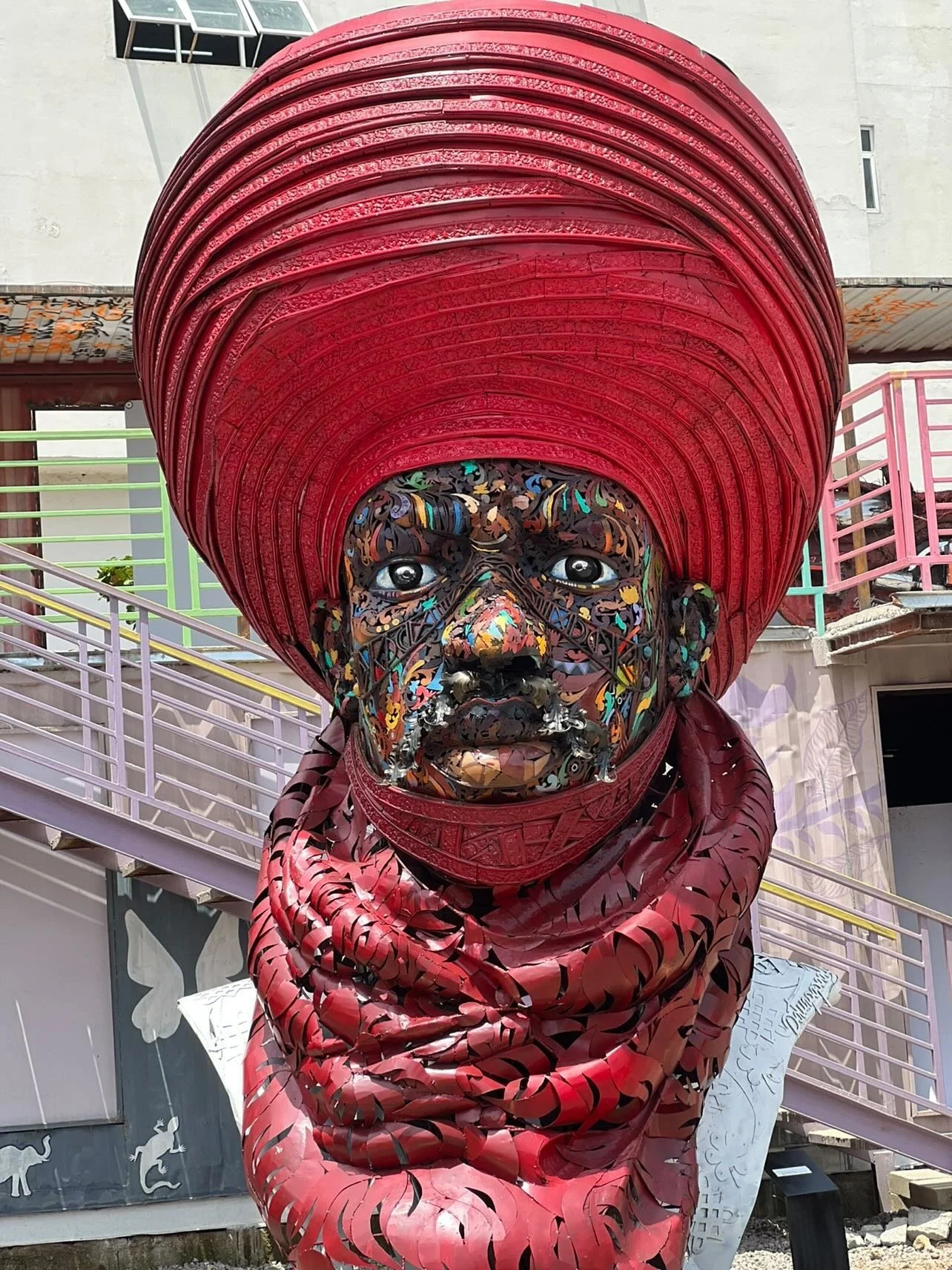
Returning to Nigeria, Popoola combined these technical skills with African storytelling, creating a practice unlike anything previously seen in Nigerian contemporary sculpture: large-scale figurative works constructed entirely from industrial waste while maintaining the anatomical precision and emotional resonance typically associated with bronze or marble.
As Popoola often explains, his mission is simple:
"Transforming trash to treasures, rubbish to rubies and waste to wealth."
That philosophy also defines the Scrap Art Museum he later founded, where another guiding principle echoes throughout its programming:
"Junk is just unmade art."
Reclaimed Beauty: A Dialogue Between Continents
An Exhibition That Commands Attention
Popoola's eighth solo exhibition, Reclaimed Beauty: A Dialogue Between Continents, represents perhaps the clearest expression yet of his artistic philosophy.
Running from June 13 to September 30, 2026 at The Village by Tikera in Abuja, the exhibition attracted more than 200 prominent guests on opening night, including Nigeria's Minister of Arts, Culture and Creative Economy, Hannatu Musawa.
The turnout reflected Popoola's place within Nigeria's contemporary cultural landscape—not as an emerging artist seeking recognition, but as one whose exhibitions have become significant national cultural events.
Sculpture Within Sculpture
Among the exhibition's most compelling works is a monumental tribute to Nobel Laureate Wole Soyinka.
Embedded within the larger sculpture is an intricately crafted alligator that, remarkably, functions as a complete artwork in its own right.
Rather than treating details as decorative elements, Popoola constructs each component with the same seriousness and independence as a standalone sculpture. The result rewards viewers on two levels: from afar, the monument appears unified; up close, it reveals dozens of fully realised works nested within a larger composition.
Finding Beauty in Everyday Objects
Elsewhere in the exhibition, Popoola transforms ordinary forks and spoons into delicate feathers covering birds poised between flight and stillness.
The sculptures showcase not only imagination but extraordinary craftsmanship. Every utensil is individually sourced, welded and positioned so the finished works capture changing light and movement from every viewing angle.
The result is months of meticulous labour hidden beneath an effortless visual illusion.
A Cross-Continental Conversation
The exhibition earns its subtitle by creating dialogues between cultures rarely presented together.
One work brings Native American symbolism into conversation with Northern Nigerian aesthetics. Another, The Swift Ascendant, was created in collaboration with the House of Martell, challenging conventional ideas of luxury by demonstrating that true value lies not in expensive materials but in extraordinary vision.
Underlying the exhibition is a broader social message.
Popoola encourages young Nigerians to see opportunity where others see waste. His own career—built from discarded industrial materials—serves as tangible proof that creativity can generate both cultural significance and economic opportunity.
Beyond the Exhibition, Building an Institution
In 2020, Popoola founded the Scrap Art Museum in Ile-Ife, the first institution of its kind in Africa dedicated to sustainability, innovation and environmental art.
The museum hosts conferences, educational workshops and mentorship programmes for emerging eco-artists, extending Popoola's influence beyond his own practice.
His sculptures have also represented Nigeria internationally, appearing at Expo 2020 Dubai and COP29 in Azerbaijan while entering collections across the world.
The Man Behind the Exhibition
Bayo Omoboriowo's Vision
An exhibition of this scale required a curator capable of matching its ambition.
That role belongs to Bayo Omoboriowo, the founder of Tikera Africa and former official photographer to Nigerian President Muhammadu Buhari.
His experience documenting political power has evolved into building cultural infrastructure, culminating in The Village by Tikera, a 32-hectare creative campus constructed largely from salvaged materials—including aircraft fuselages, railway components, shipping containers and reclaimed timber.
Rather than simply housing the exhibition, the venue reinforces its central argument before visitors encounter a single sculpture. The architecture itself becomes part of the exhibition.
More Than Sculpture
A Blueprint for Africa's Creative Economy
Ultimately, Reclaimed Beauty: A Dialogue Between Continents argues something much larger than the artistic value of recycled materials.
It proposes that industrial waste…the discarded remnants of globalisation, can become the foundation of genuine cultural and commercial value.
This is not simply a metaphor for resilience.
It is a working economic model supported by an international exhibition circuit, a museum, institutional partnerships and verified commercial success.
Through Popoola's sculptural practice and Omoboriowo's architectural vision, Abuja has become a global meeting point for conversations about sustainability, creativity and the circular economy—expressed not through policy papers but through welded steel, reclaimed cutlery and buildings reborn from discarded materials.
Together, they offer one of the most compelling demonstrations anywhere in the world of what a circular economy can look like when driven by imagination, craftsmanship and ambition.