Ginton and ODUMODUBLVCK Reach Across Generations to Rework Fela Kuti
By Kimberley Dooshima Jev
As a musician with understanding, you don’t just casually touch Fela’s music. Fela Anikulapo Kuti left behind more than a catalogue. The Nigerian musician, activist and architect of Afrobeat built a musical language from jazz, funk and African rhythmic traditions and used it to confront power. His music challenged military rule, colonialism, corruption and political authority, making the work inseparable from the social and political history surrounding it.
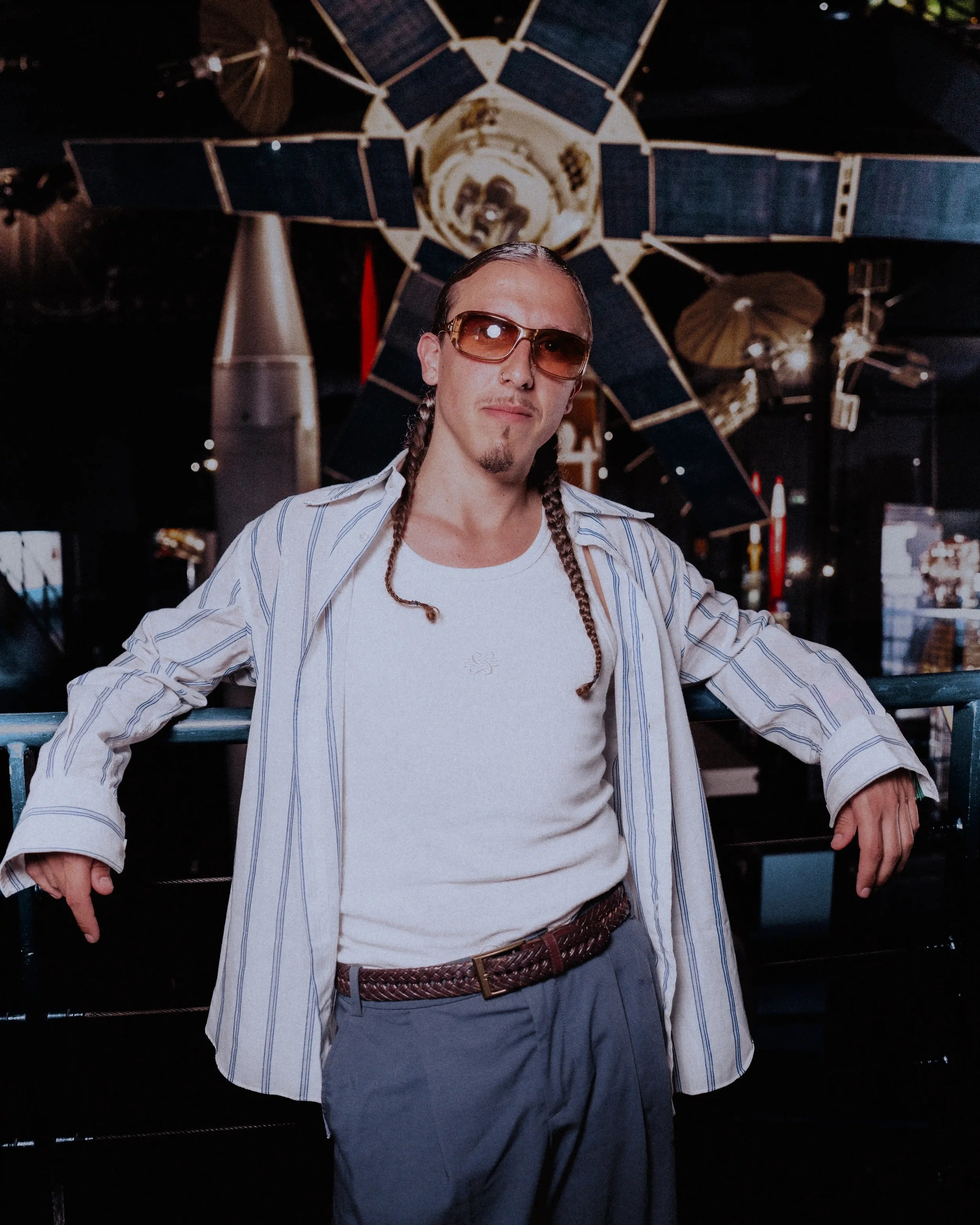
So when Amsterdam-based DJ, producer and guitarist Ginton turns toward Fela’s “Beasts of No Nation,” there is history sitting inside the music before the first new note is added.
This August, Ginton joins Nigerian rapper ODUMODUBLVCK for “No Nation (Ayakata),” a contemporary reworking of the Fela classic made with the involvement of the Fela Kuti Estate.
The source material carries a particular kind of weight. Written following Fela’s release from prison in 1986 and released with Egypt 80 in 1989, Beasts of No Nation expanded his political gaze beyond Nigeria, taking aim at apartheid South Africa and global political figures including P.W. Botha, Margaret Thatcher and Ronald Reagan. Fela’s provocation was characteristically direct: the “beasts” were not confined to one nation.
More than three decades later, Ginton hears a message that remains unfinished.
“Being the first artist to officially rework a Fela Kuti song is a huge honour for me. Beasts Of No Nation is about freedom, being yourself, and the idea that your dreams should not be limited by where you come from. That message is still very important today, and I’m proud to share it with a new generation.”
That new generation has an unmistakable voice in ODUMODUBLVCK — and for readers of Afros in tha City, his presence here should feel less like an introduction than the continuation of a story.
We were watching in 2023 as EZIOKWU Deluxe pushed the Abuja rapper’s world further outward. At the time, Afros wrote about the principles and ambition underpinning the project: his fierce loyalty to the Anti World Gangstars collective, his refusal to abandon his own sound as the stages became larger, and a Pan-African instinct that brought artists including Nasty C, Black Sherif, Teni and Masicka into the same sprawling musical universe.
Three years later, he has kept moving.
ODUMODUBLVCK’s profile is larger. The conversations around him are louder. He remains just as resistant to sanding down the edges that made him compelling in the first place. That extends beyond his records. Follow him online for any length of time and it quickly becomes clear that silence is not particularly his thing. He speaks freely, argues his position and regularly challenges the assumptions, hierarchies and unwritten rules surrounding the music industry.
That matters here.
Back in 2023, Afros wrote that ODUMODUBLVCK would “stick to his sound, his friends, his ideals and his principles.”
So far, he has given us little reason to change our minds.
His appearance on No Nation (Ayakata) doesn’t suddenly place ODUMODUBLVCK in conversation with African musical history. That conversation has been developing throughout his work. What changes here is the proximity. Fela’s music is no longer simply part of the lineage surrounding contemporary Nigerian sound. It becomes the source material itself.
Drawing a straight line between ODUMODUBLVCK and Fela would be historically careless. Different artists. Different eras. Different stakes. But there is something fitting about an artist who refuses easy containment stepping into music created by another Nigerian artist who understood exactly what could happen when you refused to behave as expected.
For Ginton, crossing musical borders is familiar territory too.
Trained in jazz guitar at the Conservatorium in Rotterdam, he first drew wider attention as a co-producer on Drake’s “Tie That Binds” from the chart-topping Honestly, Nevermind. His catalogue has since expanded through collaborations with Richard Bona, Salif Keita, Stonebwoy, MoBlack and Francis Mercier, while his Woody Trees imprint explores the space between electronic production, live instrumentation and global rhythms.
That catalogue has increasingly put contemporary production into conversation with established musical legacies. Ginton teamed with Richard Bona and Salif Keita for a modern reimagining of “Kalabancoro” and, more recently, released an official remix of Nina Simone’s “I Am Blessed.”
Now it is Fela.
“Fela was one of Africa’s most important artists and a true pioneer,” Ginton says. “He mixed jazz, Afro-folk and soul to create Afrobeat. His music really inspires me. I’ve always liked mixing different sounds and cultures to make music that goes beyond borders.”
With ODUMODUBLVCK, that instinct reaches across generations.
“Working with ODUMODUBLVCK to connect Fela’s era with today’s African sound is a real privilege. I’m very thankful to the Fela Kuti Estate for trusting me with this song and giving me the chance to bring it to new listeners.”
Fela’s era. Ginton’s interpretation. ODUMODUBLVCK’s generation.
No Nation (Ayakata) doesn’t need to replace Beasts of No Nation, nor does a new generation need to recreate Fela to prove his influence. The connection is already there. It lives in artists willing to cross borders, challenge convention and take African music somewhere it hasn’t been before.
Nearly four decades after Beasts of No Nation, the players have changed and African music occupies a radically different place on the global stage. It is clear as with all Fela’s recordings, the record still has something to say.