By Kimberley Dooshima Jev
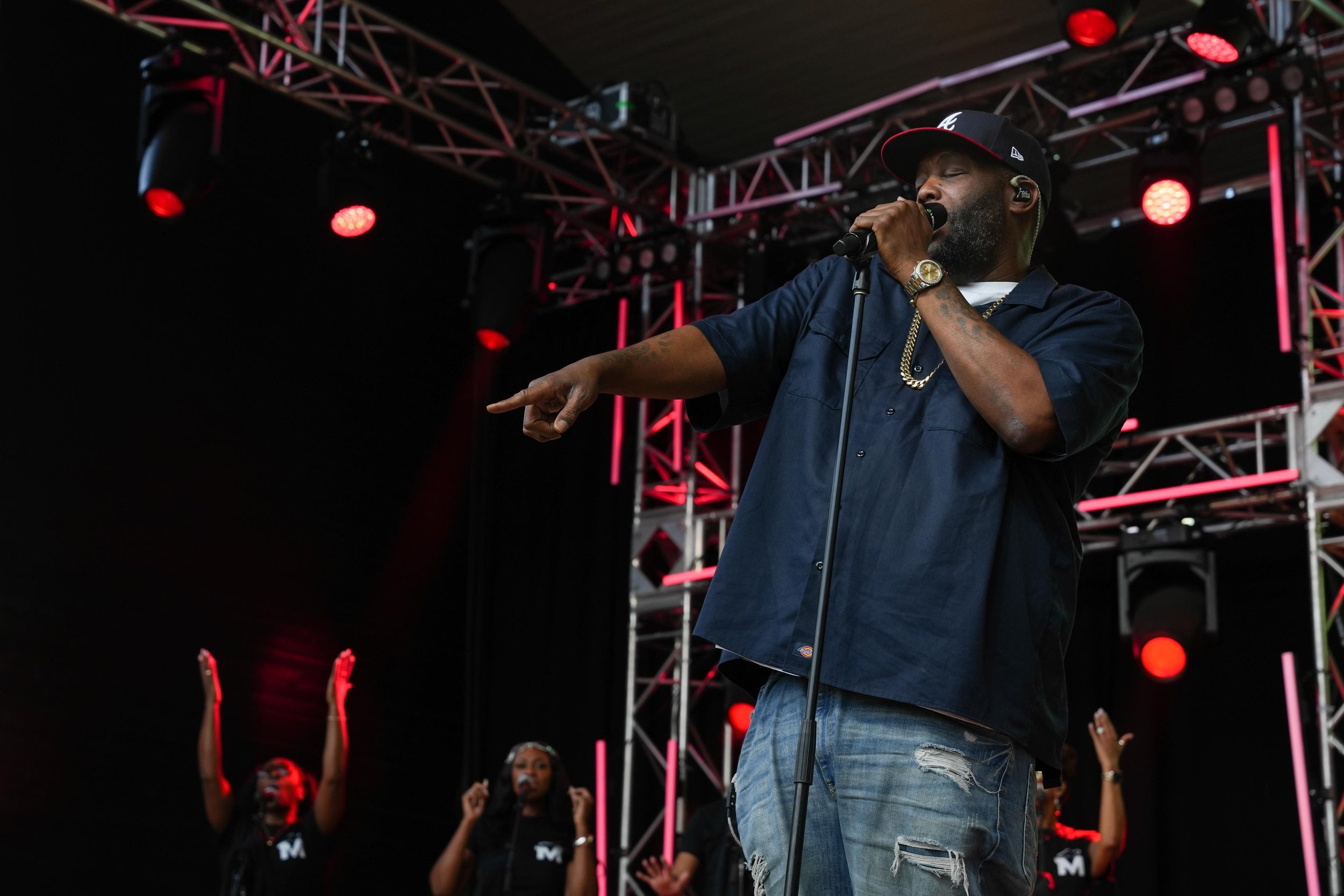
Killer Mike - Photography by Emma Ryan
How Killer Mike brought Atlanta to Calgary Folk Music Festival
By Kimberley Jev
There are moments in journalism when you stop chasing the story because the story quietly finds you. That afternoon, I wasn't looking for Killer Mike. After several days of interviews, walking Calgary's neighbourhoods and criss-crossing Prince's Island, I found a quiet place at the back of the main stage grounds. By then, the festival had become more than a series of performances. It had become a way of moving through the city itself. I wasn't interviewing anyone. I wasn't taking notes. I was simply sitting, decompressing, letting the weekend settle around me. The festival carried on. Then the soundcheck began.
I grew up in the MTV generation. Long before I knew Atlanta as a city, I knew it as a feeling. It lived in music videos after school. It lived in OutKast, Bone Crusher, Crime Mob, and the records that carried Atlanta's sound far beyond Georgia. My first real connection to Killer Mike came through OutKast's Grammy-winning "The Whole World." For more than two decades, that music has travelled with me. Then came 2006. That summer, ATL seemed to be everywhere. It wasn't simply a movie. It gave Atlanta texture. Roller rinks. Neighbourhoods. Family. Humour. Southern hip hop. It made a city I'd never visited feel strangely familiar.
Years later, Run the Jewels became another chapter in that relationship. As Michael Render's career expanded, so did my understanding of him. I watched him grow beyond the artist I first encountered, becoming not only a rapper but a community leader, entrepreneur and public voice whose conversations stretched beyond music into justice, politics and Black economic empowerment. So when Killer Mike walked onto the Calgary Folk Music Festival stage, I wasn't discovering him. I was reconnecting with someone whose journey had continued to unfold alongside my own.
One of the realities of journalism is that not every artist should be interviewed simply because you have the opportunity. Some conversations deserve more than fifteen rushed minutes squeezed between soundcheck and showtime. Killer Mike was one of those artists. So I made a different decision. I watched. I listened.
Sometimes experiencing the work is the reporting. What followed didn't feel like a conventional hip hop concert. It felt like Atlanta had arrived on Prince's Island. Killer Mike spoke candidly about getting healthier and feeling better. He laughed with the audience, paid homage to the artists who shaped him and celebrated the city that raised him. At one point, he looked out into the crowd and said:
"If you've got something to say to the world that's going to make it a better place, say that thing right now."
It didn't feel like a slogan. It felt like an invitation. The Mighty Midnight Revival remained at the centre of it all. Their voices had reached me before the artist himself. Hip hop. Gospel. Soul. Storytelling. Testimony. None of them competed. They completed one another.
At one point, I caught myself thinking something I never expected. I want to go to church in Atlanta. Not because I suddenly understood Atlanta but because I realized there was still so much I wanted to learn about the place that could produce something like this.
In our conversation after the festival, TeaFannie told me she had thanked Killer Mike personally.
"I just let him know how important what he did on that main stage was," she said. "For an artist like me in the city, for the whole crowd to be singing those lyrics back to him... it was very empowering."
Her words stayed with me. She wasn't talking about a viral moment. She was talking about a career. A body of work. A life in music. In an era when success is so often measured in streams, clips and follower counts, there was something grounding about witnessing an artist whose legacy has been built record by record, performance by performance and community by community. TeaFannie also pointed to moments that mattered closer to home: seeing Julian Taylor perform with Calgary bassist Lisa Jacobs, named Musician of the Year by Country Music Alberta in 2024 and Bass Player of the Year by both the CCMA in 2024 and Country Music Alberta in 2025.
She reflected on the care with which Artistic Director Kerry Clarke curates the festival, creating space where local artists stand alongside internationally celebrated ones. Taken together, those moments revealed something larger than a single performance. They revealed a festival invested in legacy.
As I thought about the weekend, I realized this story had never really been about one concert. It was about what happens when culture accompanies you long enough that it begins to feel like family. Not because everyone shares the same experience. Not because we are a monolith but because stories travel. Songs travel. Films travel. Records travel. They move across oceans, across generations and across communities, carrying pieces of home with them until one day they meet you where you are.
For me, that meeting happened on Prince's Island. I remember the soundcheck. Before Killer Mike stepped onto the stage. Before the introductions. Before thousands gathered in front of him. A choir sang across the island. The sound reached me before the artist did. Sound before sight. And on that Sunday, Calgary listened.