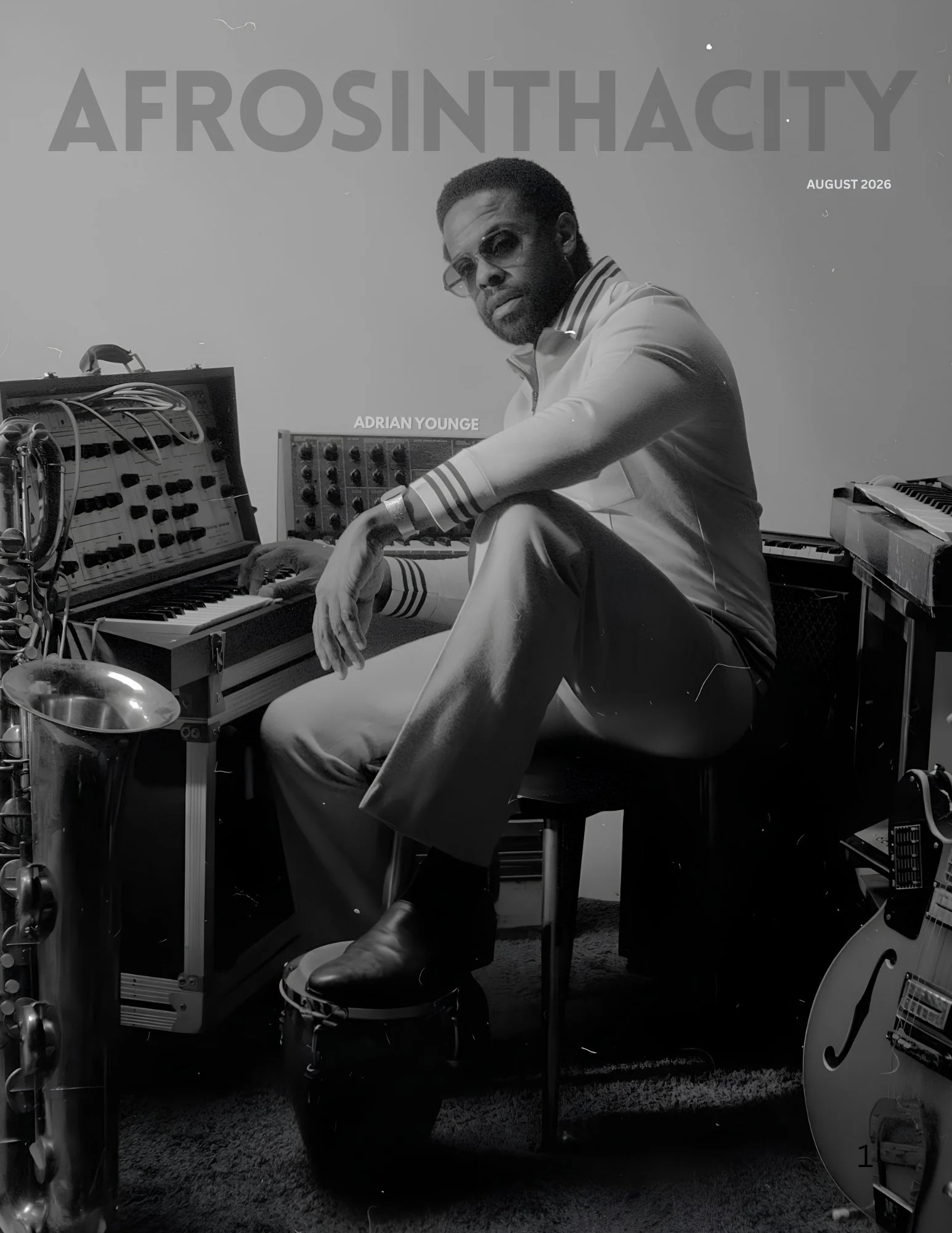
Adrian Younge on Craft, Lineage and the Music That Refuses to Stand Still
By Kimberley Dooshima Jev
During interviews the recorder becomes the most important object in the room. With this one, that wasn't one of them.
When Nate and I arrived early backstage at the Calgary Folk Music Festival, we expected to wait. Adrian Younge had just stepped off stage after presenting Jazz Is Dead, joined by Brazilian soul legend Carlos Dafé, acclaimed saxophonist Ronnie Laws and vocalist ALA.NI.
Instead, something quieter happened. Before introductions. Before credentials. Before anyone knew who we were. There were smiles. Nods. Simple greetings exchanged between people who had never met.
It was a small moment, but it established the tone long before the recorder captured a single word. The atmosphere wasn't rushed or transactional. It felt grounded. Respectful. Almost familial.
By the time Adrian Younge sat down across from us, Carlos Dafé remained beside him. I didn't yet realize how important that detail would become.
I also didn't realize that my opening question would end up framing our entire conversation. "I've been wrestling with the title Jazz Is Dead," I told him. "The more I look at the project, the less it feels like nostalgia. Is it resurrection? Restoration?"
Younge smiled. It wasn't the question he seemed to expect. Then he answered in a way I hadn't anticipated.
"It's not about whether it's old or whether it's new," he said."It's about quality... I'm about being classic."
That single sentence dismantled almost everything I thought I understood before walking into the interview.
Not nostalgia. Standards.
It's easy to mistake Adrian Younge's work for nostalgia. The analog tape machines. The orchestral arrangements. The collaborations with legendary artists. The visual language.
Everything appears to point backward. But listening carefully, Younge consistently rejects that interpretation. For him, analog recording isn't an aesthetic preference.
It's a standard.
"Everything I do is analog," he explained. "There's no computers in my studio... I shoot film. I develop film. I print film. Everything I do is analog because, for what I do, it's simply the best."
Notice what he didn't say. He never argued that digital music was inferior. He never suggested artists should reject technology.
Instead, he described choosing the tools that best served the work he wanted to make. That distinction matters. Later in our conversation, the man who had spent several minutes passionately describing tape machines and craftsmanship casually told me that if I wanted to stay in touch… "Just message me on Instagram." For a moment I laughed internally.
The supposed champion of analog had directed me to one of the world's largest digital platforms. Then I realized there wasn't a contradiction at all.
Younge isn't committed to old tools. He's committed to intentional ones.
Analog serves the music. Instagram serves communication.
The principle remains the same. Only the tool changes.
From the Sampler to the Symphony
One of the most revealing moments came when Younge described how his relationship with music evolved.
He began, like many hip-hop producers of his generation, by making beats from samples. Then something happened. The records he was sampling began inspiring him more than the beats he was creating.
So he put the sampler away. He picked up instruments. Drums. Keys. Guitar. Flute. Saxophone.
He bought books. He taught himself orchestration. "I always tell people," he said, "I came from the sampler to the symphony." It's a remarkable sentence because it explains his entire career.
Hip-hop didn't disappear from his work. It became the lens through which he understood composition. Sampling taught him what moved people. Learning orchestration taught him how those moments were built. That journey from curiosity to discipline still shapes every project he undertakes.
"I Don't Create for Props"
If there is a mission statement hidden inside Adrian Younge's catalogue, it arrived midway through our conversation.
"I don't create for props," he said. "I create to inspire."
Everything else suddenly made sense.
Why he learned orchestration. Why he works with living legends. Why he answers messages from young artists. Why he spends years developing projects that may never become commercial successes. The work isn't designed to generate applause. It's designed to encourage someone else to begin.
Continuing the Conversation
At one point Younge paused the interview. He turned toward the man sitting beside him.
Carlos Dafé. He wasn't content simply introducing him as a collaborator. He wanted context.
He spoke about Brazil's Black consciousness movement. About James Brown's influence.
About soul music becoming a language of Black identity in 1970s Brazil. About why Carlos Dafé became known as the country's Prince of Soul. Suddenly this wasn't an interview about Adrian Younge anymore.
It was about lineage. About understanding that music doesn't exist in isolation.
It travels. It evolves.It crosses oceans.
For Younge, collaborating with Carlos Dafé isn't an act of revival.
It's a continuation of a conversation that began decades ago.
Proof of Concept
One of the most revealing answers Adrian Younge gave wasn't about music at all.
It was about access.
In journalism, people often ask successful artists some version of the same question:
"How did you get to work with all these legends?"
The answers usually revolve around management, labels, agents or introductions.
Younge's answer was different.
He spoke instead about proof of concept. Before Jazz Is Dead. Before touring internationally. Before Carlos Dafé. Before Ronnie Laws. Before Tony Allen. Before Ebo Taylor. There was one project. Then another. Then another. Each one quietly proving that he understood not only the music, but also the responsibility of working with artists whose careers had already shaped generations.
His first major collaboration with William Hart of The Delfonics became a turning point.
"That was proof of concept," he explained.
Ghostface Killah followed. More collaborations followed. Eventually, Jazz Is Dead no longer had to convince artists that the idea would work. The work spoke first. Listening to him, I realized something important. The music industry often celebrates networking. Adrian was describing something else entirely.
Trust.
Trust isn't built through introductions.
It's earned through consistency.
Over time, artists began recommending one another. Marcos Valle encouraged others to work with Adrian and his longtime creative partner Ali Shaheed Muhammad.
Doors opened not because someone held them open, but because people on the other side believed the work would be treated with care.
That distinction matters.Especially in an era obsessed with shortcuts.
Law School and the Architecture of Independence
Adrian Younge is often introduced as a composer, producer and multi-instrumentalist. Less frequently mentioned is the fact that he studied law. At first glance, it feels like an unexpected detour. It wasn't. "The reason I got an education," he told me, "was because I wanted to be an educated artist."
He didn't go to law school because he intended to spend his life inside a courtroom. He wanted to build something that belonged to him. Understanding contracts. Understanding ownership. Understanding intellectual property. Understanding the business that surrounds art.
Those weren't distractions from creativity. They became part of it. Listening to him explain this, I couldn't help thinking about independent publishing.
At Afros in tha City, independence isn't simply an editorial position. It's infrastructure.
It has meant understanding printing costs. Distribution. ISSNs.Copyright. Advertising. Business registration. Editorial ethics. Creative work cannot exist without the systems that protect it.
Adrian's perspective reminded me that independence isn't a romantic idea.
This is a discipline.
Bigger Kids
Late in our conversation, Adrian softens when talking about legendary musicians.
Then he said something beautifully simple. "We're just bigger kids." It may have been the most profound sentence of the afternoon. Because we often freeze legendary artists in history. We speak about them as though they belong to another era.
Adrian doesn't. He speaks to them. One of the quietest heartfelt moments of the afternoon had nothing to do with the interview itself. Adrian never treated Carlos Dafé as a silent figure sitting beside him. Throughout our conversation, he continued speaking with him, moving between English and broken Spanish with the same ease and patience he brought to every answer. The exchange wasn't about fluency. It was about the practice of respect in relationship.
Adrian works consistently, non-stop, he works, he laughs, he challenges himself and his collaborators. He is constantly creating new music alongside them.
He reminded me that Ronnie Laws, Carlos Dafé, Tony Allen, Ebo Taylor and countless others are not museum exhibits. They are artists. Artists who still have something to say.
That perspective quietly reshapes Jazz Is Dead.It isn't a historical preservation project.It is an invitation for living artists to continue creating.
The Ecosystem
Throughout our conversation I kept returning to one word.
Ecosystem.
It's a word I've used repeatedly while building Afros in tha City because culture has never felt like a collection of isolated stories. Every interview leads to another artist. Every community introduces another community. Every relationship expands the map.
When I mentioned Nigeria, Liberia, Ghana and our work connecting Black communities through journalism, Adrian immediately understood what I meant.
There was no need to explain why those connections mattered.
He was already living them.
Jazz Is Dead itself is an ecosystem.
Los Angeles.
Rio de Janeiro.
Accra.
Lagos.
London.
Cameroon.
Brazil.
The Caribbean.
Jazz.
Hip-hop.
Highlife.
Makossa.
Soul.
Afrobeat.
These aren't separate conversations.
They're chapters of the same story.
A Different Kind of Dance Record
A week after our interview, Linear Labs announced Adrian Younge's newest project.
Afro-Disco Makossa.
Reading the announcement felt strangely familiar.
Not because it repeated the interview but because it confirmed it.
The album is described through a question rather than a genre:
What would a Ghanaian producer in 1976 have made if he set out to create an American disco record for his hometown?
That isn't marketing language.
It's methodology.
During our conversation Adrian repeatedly spoke about continuing conversations rather than recreating history.
The press materials echo that exact philosophy, describing the album not as a tribute to Afrobeat but as "a continuation."
That single word stayed with me.
Continuation.
Not revival.
Not restoration.
Not nostalgia.
Continuation.
The distinction is subtle.
It is also everything.
Younge didn't arrive at Afrobeat through imitation.
He arrived through relationships—with Tony Allen, one of Afrobeat's architects, and Ghanaian highlife pioneer Ebo Taylor. Those collaborations weren't exercises in borrowing a sound. They were built on shared time, shared work and mutual respect. Afro-Disco Makossa grows from that foundation, asking where those musical conversations can travel next rather than where they began.
What Survives
As our conversation came to an end, I realized I had walked into the room expecting to interview a musician.
Instead, I had spent a precious moment with someone thinking deeply about systems.
How music is learned.
How trust is earned.
How craftsmanship is preserved.
How elders continue creating.
How young artists find the courage to begin.
Perhaps that's why Adrian never seemed particularly interested in defending the past.
He wasn't trying to convince anyone that yesterday was better.
He was asking a different question altogether.
What deserves to survive?
And if it does survive...
How do we carry it forward without turning it into a museum?
That may be the real work of Jazz Is Dead.
Not keeping history alive but ensuring it never stops speaking.