The Practice of Joy
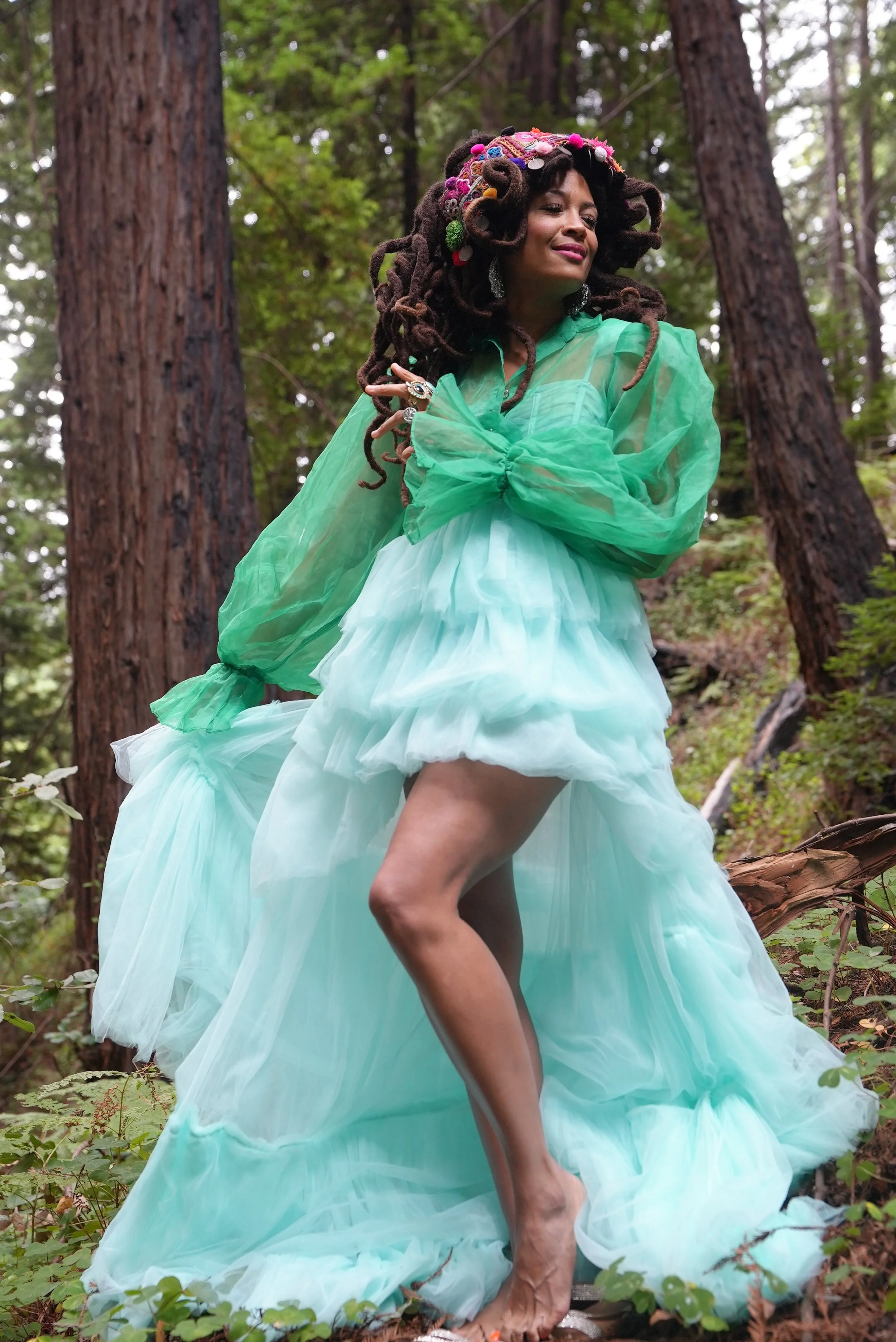
A fifteen-minute conversation with Valerie June became something much larger than an interview about an album.
By Kimberley Dooshima Jev
Festival interviews rarely happen the way you imagine them.
Artists move between soundchecks and stages. Publicists watch the clock. Journalists quickly learn that every question has to earn its place because time takes on a different meaning. Minutes become months, hours become seasons, and days feel like lifetimes. Our moment is brief.
Our story, as stories sometimes do, began with a misunderstanding.
Somewhere between the media tent and the Artist Section at the Calgary Folk Music Festival, schedules had crossed, and by the time we arrived, Valerie June believed we were late.
For a moment, dread settled in. It felt as though we had missed our window.
It's important to stay calm in moments like these.
Timing becomes everything. An opportune current of energy weaves around you, the communal rhythm of festivals carrying everyone forward.
"We just saw her!"
The words were almost whispered as encouragement that the interview would indeed take place.
It's like a movie.
It's a summer day.
It's hot.
The festival is alive.
The pressure is immense.
And yet, I am at my calmest these days.
"I've only got a few minutes," Valerie June says with a nod. "I'm meeting a friend."
A gracious moment of understanding. This is our first conversation.
She doesn’t know me. We don’t know each other. We had fifteen minutes, and every one of them mattered.
We sat down beside one another, sunglasses still on, looking directly at each other.
Evaluating.
Which way is this going to go?
Nobody talks about the quiet evaluation that happens when two independent Black women sit next to each other for the first time.
Nobody talks about that aura enough.
I will.
Then, quietly, something shifted.
Not because anyone suddenly had more time or because I asked the perfect question.
The conversation simply found its rhythm. The guards came down. The conversation replaced the evaluation. This conversation wasn't entirely about music.
Valerie June had already given the audience what they came for. Her music is celebrated around the world, and she is spending the summer touring with Ani DiFranco.
I don't need to spend these pages proving what we already know is beautifully crafted work.
Valerie June is an artist, yes. But she is also a business.
Our conversation speaks to creativity. We explore the meaning of community. We explore spirit.
We talk about what it means to build a life that still resembles your values long after success arrives. By the time our interview ended, we had barely spoken about the album that brought her to Calgary.
Instead, Valerie June had quietly given language to questions I had already begun asking myself about art, independence and the future of Afros in tha City.
An Artist Who Refuses Categories
Valerie June has never been easy to categorize.
Born in Jackson, Tennessee, the Grammy-nominated singer-songwriter has spent more than two decades building a body of work that draws from Black musical traditions while weaving together folk, blues, gospel, soul, country and Appalachian music into something unmistakably her own. Beyond music, she is also a poet, author and mindfulness practitioner whose creative philosophy extends far beyond songwriting.
Critics have often struggled to describe her because her work refuses simple labels. Rather than belonging to a single genre, her music moves comfortably between traditions, honouring each without becoming confined by any of them.
Her latest album, Owls, Omens and Oracles, continues that journey. The record explores imagination, intuition and interconnectedness, treating joy not as escapism but as a deliberate practice that allows people to remain open in an increasingly fractured world.
Listening to Valerie June speak, it quickly becomes clear that the album isn't separate from her life.
It grows directly from it.
Joy Is a Practice
People often describe Valerie June's music as joyful. Listening to her speak, I realised joy isn't something she performs. This isn't an act for the sake of performing. It's something she lives through.
Joy is a mantra she chooses every day.
"I think I communicate through creativity," she told me. "Because we all carry good and bad within us. Which one do you want to put your energy into?"
It's an answer that sounds almost disarmingly simple until she explains what that philosophy looks like in practice.
"It's not like I stop my life," she said. "The practices of ten minutes to retune myself are part of my daily life. Folding clothes, I'm doing my meditations. My affirmations. Whatever it is... cleaning the toilet. I'm doing the things I need to do in my mind space for the spirit to stay tuned."
The room resonated.
To my right sat our July cover subject, Judith Demosthene. Directly across from me sat our business mentor and advisor Nathan-Holland Jones. They were two contributors I had deliberately invited to share this rare opportunity with me, not simply to witness the conversation, but to experience it together. Three people. Three lives. Three different perspectives evaluating the same moment.
The atmosphere shifted, not because spirituality was being reduced to household chores, but because Valerie June had just made the profound act of putting faith into practice feel wonderfully ordinary.
There was no performance.
No carefully curated image of wellness.
Just someone who had discovered that extraordinary lives are often built through remarkably ordinary habits.
She leaned back comfortably, her hands gently poised together.
"I'm not just jogging," she said. "I'm saying, 'Thank you because I am healthy. Thank you because I am strong. Thank you because we're all growing to be kinder, sweeter human beings.'"
Everything, she explained, becomes "a constant connection." It is a phrase simple enough to overlook. It is also profound enough to build a life around.
There is discipline there.
Small Is Powerful
Valerie June's career has unfolded differently from many of her contemporaries.
Rather than pursuing celebrity for its own sake, she has quietly built a sustainable independent career, earning Grammy recognition while collaborating across genres and releasing acclaimed albums including The Order of Time, The Moon and Stars: Prescriptions for Dreamers, and now Owls, Omens and Oracles. Her success has never depended on fitting neatly into one category.
It has come from trusting the work itself.
Perhaps that's why the next thing she said carried so much weight.
"I like things that are very small," she said. "I think small is powerful."
She said it calmly while describing an industry fascinated by superstardom.
"People want to be huge stars. They want to be as big as superstars, Taylor Swift, Jay-Z, Beyoncé. But I think it's just as beautiful as artists who can exist... very small."
Then she explained why.
"I've been living off my art for two decades now. I'm a Black woman running my business."
"It isn't easy. But it's really about the community and the people."
Then she asked herself a question that lingered long after she spoke it.
"I always have to ask. Is this healthy for me?"
I sat with that for a moment because it was then I realised it wasn't simply the question she asks herself.
It was the question maybe we haven't been asking often enough.
Independent media has become remarkably good at measuring growth.
We are often told success comes with more readers. More followers. More reach. More visibility. More social. More web. More engagement. Virality.
We’re constantly trying to fit ourselves into a mould built for behemoths.
Yet sitting across from Valerie June, another definition of success quietly entered the room.
What if longevity is success? What if the community we have nurtured is the success? What if building something that still reflects your values twenty years later is success? What if we are doing just fine in our own defined way? What then?
Build Another Platform
Later, our conversation turned toward something many Black creatives understand instinctively.
What happens when your work is flattened? When the energy is stripped from it in the name of being "marketable"? What happens when your perspective is edited into something easier for other people to consume?
It's something we adamantly push back against at Afros in tha City.
She nodded before I had even finished the question.
"As a Black woman," she said, "our experience is to be flattened pretty much daily."
Calm. Cool. Collected. There was no bitterness in her voice. Only recognition.
Then came the sentence that stayed with me long after we left the media tent.
"If this isn't the platform for this... let me go over where I see space and start creating because that's the platform."
There's no resentment. No waiting. No begging. Only creation. What she brings into focus is self-defined permission. Permission to move without trying to force yourself into a space that was never built for you.
I felt that.
On this journey, I've felt that. I won't beg for space. I can only build foundations on the space I choose for myself.
When I walked into the room, I thought I was there to ask Valerie June about an album.
This would have been the easier route. The familiar route. The palatable route for interviewing musicians. Instead, she quietly articulated why independent publications like Afros in tha City matter.
She gave language to something we both understood.
What we do is a business. Not a fairy tale.
Sometimes we spend so much energy trying to earn a seat at someone else's table that we forget we can build our own.
That, too, is the work.
When Do You Know the Music Is Working?
In an era dominated by algorithms and streaming data, I asked Valerie June how she knows whether her music is reaching people.
Her answer had nothing to do with numbers.
"If I feel like I need some kind of proof that I'm connecting with the audience," she said, "then I talk to Spirit."
She smiled.
"Spirit will do things like... somebody will stop me in the grocery store and say, 'My sister was passing and we listened to your song.' Or somebody says a baby was born and we played that poem."
She paused.
"Okay... the music is working where it needs to."
It's remarkable. It's real. It's deeply moving. It isn't a Spotify Wrapped. It isn't a Billboard chart position. It's resonance.
The impact of a song cannot always be counted. Sometimes it carries someone through grief.
Sometimes it welcomes new life. Sometimes it simply arrives exactly when it is needed. Valerie June is not just successful, she is deeply human.
Keeping Joy
The conversation reached its deepest place almost without either of us noticing. Valerie began speaking about her ancestors. About growing up in the American South. About carrying generations of unimaginable pain while refusing to allow pain to become the only inheritance.
Sometimes, she said, she imagines her ancestors dancing. Other times, she imagines those whose lives were stolen through racial violence. Both truths exist together. Neither erases the other.
"They have been through so much," she said. "Yet I sit here free... talking about joy."
Then she offered a sentence that has stayed with me ever since. "I'm keeping my joy because they would want me to."
In that moment, joy became something much larger than happiness. It became remembrance.
Resonance. Responsibility. An inheritance carried forward through the ordinary acts of living.
Fifteen Minutes
Festival interviews end the same way they begin.
Someone else is waiting.
Something else is calling.
The next stage.
Another interview.
Or simply the opportunity for the artist to step back into the world and reconnect with friends, family and the people they meet along the way.
Another schedule has to be kept.
Valerie June smiled, thanked us, and before leaving mentioned that she had already come across Afros in tha City before we met.
It was a small moment. Easy to overlook. But this wasn't a small moment.
I walked away carrying something much larger than a notebook full of quotes and a recording.
In the days that followed, I found myself returning to those fifteen minutes more often than I expected. Not because Valerie June gave me easy answers. She didn't. She gave language to something I had only just begun to understand.
Looking back now, this was the conversation that clarified what this publication continues to stand for. Afros in tha City is a publication less interested in chasing scale than cultivating community. Less interested in permission than creation. Less interested in fitting neatly into existing spaces than building new ones.
I thought I was walking into a conversation about an album.
Instead, I walked into a conversation about independence.
About intention.
About the quiet discipline of choosing joy, again and again, even when the world gives you every reason not to.
Sometimes fifteen minutes is enough.
Enough to ask a better question.
Enough to understand your work a little more clearly.
Enough to remember that joy is not the reward waiting for us at the end of the journey.
Joy is part of the work itself. In the end, we are free to create lives that feel organic and true to us.
Learn more about Valerie June and her work at www.valeriejune.com.